Sunday, December 13, 2015

Saturday, December 12, 2015
Brainstorming my Media Literacy Autobiography
1. What are your earliest recollections of watching television, going to the movies, or listening to the radio?
I remember watching Barney tapes as a young age to the point where they were practically ruined. I remember watching the Dukes of Hazard as my mom, grandma, and I put up the Christmas tree and decorated it. I remember Grease being rereleased in theaters when I was young, and my mom taking me to see it, and choosing a seat in the back on the isle because I always danced along with the musical numbers (I was that kid). I don't remember listening to the radio a lot, but I remember my mom playing Alan Jackson tapes all the time, and that being my first response when someone asked me who my favorite artist was. That was also my first concert when I was six years old.
2. What commercials or advertisements do you still remember from your childhood?
8. Do you have a favorite commercial or advertisement?
It's funny, but the first thought that pops into my head are the GEICO commercials. I remember the very first ones they made where the gecko was getting calls meant for the insurance company. Now he's their spokesperson! I also remember the commercial with the squirrels. You know the one. It's my all-time favorite!
I remember watching Barney tapes as a young age to the point where they were practically ruined. I remember watching the Dukes of Hazard as my mom, grandma, and I put up the Christmas tree and decorated it. I remember Grease being rereleased in theaters when I was young, and my mom taking me to see it, and choosing a seat in the back on the isle because I always danced along with the musical numbers (I was that kid). I don't remember listening to the radio a lot, but I remember my mom playing Alan Jackson tapes all the time, and that being my first response when someone asked me who my favorite artist was. That was also my first concert when I was six years old.
2. What commercials or advertisements do you still remember from your childhood?
8. Do you have a favorite commercial or advertisement?
It's funny, but the first thought that pops into my head are the GEICO commercials. I remember the very first ones they made where the gecko was getting calls meant for the insurance company. Now he's their spokesperson! I also remember the commercial with the squirrels. You know the one. It's my all-time favorite!
3. Do you remember desperately wanting to buy something as a child based on an advertisement? What was it? Why did you want it?
A Barbie car! I wanted one of those things so badly! Now that I think back, there was no reason for me to have it. My grandparents had a small orange four-wheeler that I rode around our property, so I didn't need a Barbie car also, but I remember wanting one more than anything. I also still joke with my mother that I'm still waiting for that Barbie car.
4. What are your recollections of using social media?
5. Describe a negative experience with social media.
6. Describe a positive experience with social media.
I'm combining these questions, simply because they go together and I don't feel like I have a lot to say about this. I was late to the social media bandwagon. I never had a MySpace. I hated the idea. I was against Facebook until I was in my third year of college. I still don't understand the fascination with SnapChat. Depending on how you choose to define social media, I would say my earliest uses involved using AOL Instant Messenger. There isn't really anything positive to that experience, and I don't know that I have any outstanding positive experiences with social media other than being connected to people I never see. As for negative, though, I dealt with some bullying through AIM when I was in middle school, though I didn't realize that was what it was at the time. Nowadays, I see too many politically motivated and inaccurate posts on Facebook by people who choose not to be educated, which I would classify under negative experiences as they make me avoid the site for long periods of time.
7. Describe your current media viewing habits.
I don't have a lot of time for TV or movies or really a lot of things. Which means that when I do decide to watch something, I'm usually binge watching using Hulu or some other streaming website that can provide that for me. Usually, if I can, I'm watching these on my iPad, because it's easier to view when I'm getting ready for bed instead of my computer. I also hook my laptop up to my television and watch that way. I haven't gotten completely into Netflix just yet...
9. Have you bought something recently because of an advertisement?
No. I'm more likely to buy something because I've seen it or heard about on YouTube, though. Things like makeup or other beauty products.
10. What have you read or heard recently on the radio, TV, or Internet that has caused you to have a strong reaction? Describe and explain.
I tend to avoid anything related to politics (both world and local) because I mostly just get angry. I get very distressed by people who are blatantly closed minded (which is why I avoid Facebook a lot). I have enough stress and anxiety of my life, and this is one that I avoid.
15. What approach to media literacy do you most closely align?
I've always felt that I fell in the middle of these two approaches. I don't think I fully started to understand media literacy until college, and that's far too late. I see evidence of people who have no media literacy skills at all, and it scares me how easily they are manipulated. But I also don't feel that media literacy is limited to just what we see and hear digitally. A newspaper or magazine article can be just as manipulating, so it's important that those techniques are taught as well. I think fostering a love of literature is also important. Not only are books a wonderful distraction, but sometimes they explain the faults in society far better than anything a newspaper could write.
- - - -
2. Has your relationship with media changed over time?
Yes. I started off very much against social media in my high school years. I was determined that I would never have a Facebook. Now I have several social media accounts. I mostly just post pictures of my dog and try to keep up to date with people I don't see often, so I'm not totally involved. I still find myself standing by my belief of not overly sharing information online, especially personal information.
3. Has your understanding of what it means to be literate in the 21st Century changed or evolved because of this course? How?
5. Why is it important to incorporate media literacy practices in your current or future teaching practices.
6. How will you incorporate media literacy into your future teaching practices?
My experience in this program has all worked to make me better understand literacy in the 21st Century. It's all worked together to make me understand how important it is to understand what's out there. I work with middle school, and I feel like that the perfect age to start questioning what your told in the media. I've already worked on digital media lessons with my seventh grade students, and I feel they are mature and opinionated enough to really get into it.
After Christmas Break, my kids will be reading The Hunger Games, and there are so many different lessons about the world I can teach them with this novel. One of the areas I really want to focus on, though, is the use of media in the novel. I think this an excellent example in literature of just how manipulative the media can be.
Monday, November 30, 2015
My Digital Story
My digital story is about the life lessons I learned from working with horses. I don't think that many people realize just how much can be learned when a kid engages in some sort of activity. You hear a lot of stories about how beneficial participating in sports can be, and I will argue that riding horses is a sport. There is a lot to be learned, especially when you do something for such a long period of time. I could tell you all about how riding horses helped me when I was learning to drive! But we'll save that for another time.
I ultimately decided not to change anything in my story. The main comment I received was to include more music, but I decided against this for two reasons. Number 1, and most importantly, I couldn't figure out how to overlay my music and my narration. Whoops. Secondly, I was afraid the music might distract from what I was saying, and I didn't want that. Therefore, I stuck to my original cut.
I think that my digital story could probably be an example for all of these things. I think it could most accurately go with 1 (Raise Awareness) and 3 (Create an alternate stereotype typically portrayed by mainstream media). For the first one, I'm raising awareness about how important being involved with horses can be, and that many important lessons can be learned. For the third, I feel like there's this image of little girls with ponies, and that riding horses doesn't require much thought or work. I don't think a lot of people realize just how hard those who train and ride work every day to make it all look easy.
Digital storytelling is a great way to develop digital media skills because it requires that you think about all those techniques that are used in the media. How do you want to catch the attention of your audience? What do you want to say? How do you want to say it? You have to consider each of those things while you're working on creating your own digital story, and that can make you more aware of what you're seeing. It's also helpful getting feedback from others, because you might use a technique (like humor) and not even mean to!
Thursday, November 12, 2015
Wednesday, November 4, 2015
Sunday, October 25, 2015
Brainstorming my Digital Story
1. Describe a positive scene from childhood.
When I was younger, my aunt was always the one who took me Trick-or-Treating. At seven, my cousin was born and she started joining us, as did my uncle. One year, we decided to do a group costume. My aunt, cousin, and I dressed as the Three Little Pigs. My uncle was the big bad wolf. Each time we drove to a new house, my aunt, cousin, and I would get out and run to the door, pounding and begging to be let in. A couple minutes later, my uncle would show up, doing his "I'll huff and I'll puff and I'll blow your house in" thing. We were a hit, and the people we visited had fun trying to figure out who we were (we wore masks). With halloween coming up, I thought back on all of the times and memories I have from this night, and this one is probably my favorite.
2. Describe a negative scene from childhood.
My grandfather had one of those big, old fashioned tractors. Actually, he had two. One evening in the summer, my grandfather was getting ready to put the tractor away after plowing the garden. He would always let me sit on his lap while he drove, and while he was parked in the yard, I ran to climb on. Except, I climbed up the wrong side. There was a pipe that stands on the other side, I honestly don't know what it is used for. While trying to climb up, I grabbed this pipe to pull myself up... and burnt my hand. It was really hot, and as a result, I got second-degree burns from grabbing it. I don't remember much about the race to the emergency room or what happened afterwards. They gave me a cream and wrapped my hand and I went home, but it's a story my family would tell often for years to come.
5. Identify particular "turning points".
When I was a senior in high school, my grandfather died. This would be tragic for anyone, but for me it was especially devastating. Because my father had been absent, and my mother was struggling to provide for us, I had been partially raised by my grandparents. For five years of my life, I even lived with them. My grandfather was always a father figure to me, and so him getting sick was the hardest thing I've ever dealt with in my life. This is a turning point for me in a number of ways. For one, I learned how my family and I would begin to live without someone who was incredibly important in our lives. As my grandmother says, we never realized how much he did until he wasn't around any longer to do them. In another, I found out how strong I could be. When my grandfather died, I was the one who held it together while everyone else fell apart. I helped my mom and my grandfather. I made the necessary phone calls. It was a lot at the time, especially after the months of taking care of him and the long nights spent sleeping in hospital waiting rooms. This changed a lot in my life, as it did for my family.
When I was younger, my aunt was always the one who took me Trick-or-Treating. At seven, my cousin was born and she started joining us, as did my uncle. One year, we decided to do a group costume. My aunt, cousin, and I dressed as the Three Little Pigs. My uncle was the big bad wolf. Each time we drove to a new house, my aunt, cousin, and I would get out and run to the door, pounding and begging to be let in. A couple minutes later, my uncle would show up, doing his "I'll huff and I'll puff and I'll blow your house in" thing. We were a hit, and the people we visited had fun trying to figure out who we were (we wore masks). With halloween coming up, I thought back on all of the times and memories I have from this night, and this one is probably my favorite.
2. Describe a negative scene from childhood.
My grandfather had one of those big, old fashioned tractors. Actually, he had two. One evening in the summer, my grandfather was getting ready to put the tractor away after plowing the garden. He would always let me sit on his lap while he drove, and while he was parked in the yard, I ran to climb on. Except, I climbed up the wrong side. There was a pipe that stands on the other side, I honestly don't know what it is used for. While trying to climb up, I grabbed this pipe to pull myself up... and burnt my hand. It was really hot, and as a result, I got second-degree burns from grabbing it. I don't remember much about the race to the emergency room or what happened afterwards. They gave me a cream and wrapped my hand and I went home, but it's a story my family would tell often for years to come.
5. Identify particular "turning points".
When I was a senior in high school, my grandfather died. This would be tragic for anyone, but for me it was especially devastating. Because my father had been absent, and my mother was struggling to provide for us, I had been partially raised by my grandparents. For five years of my life, I even lived with them. My grandfather was always a father figure to me, and so him getting sick was the hardest thing I've ever dealt with in my life. This is a turning point for me in a number of ways. For one, I learned how my family and I would begin to live without someone who was incredibly important in our lives. As my grandmother says, we never realized how much he did until he wasn't around any longer to do them. In another, I found out how strong I could be. When my grandfather died, I was the one who held it together while everyone else fell apart. I helped my mom and my grandfather. I made the necessary phone calls. It was a lot at the time, especially after the months of taking care of him and the long nights spent sleeping in hospital waiting rooms. This changed a lot in my life, as it did for my family.
Teaching With Current Events
What is Noteworthy?
There are three purposes for writing news: to inform, to persuade, and to entertain. Most of the time, reporters chose what to report based on their position and what will gather an audience. Tabloid reporters talk about the unbelievable things that celebrities do because it gets them more views on their blogs and sell more magazines. No one wants to believe their favorite celebrity went to rehab, so they buy the magazine to see if it could really be true. And then, when the star who is known for being a walking disaster cleans up their act, everyone has to read about it. Local newspapers might report differently on an event then the national media, because they're part of what's going on and understand the situation better, whereas the national media might just want a news story. Point of view has a lot to do with how and why stories are chosen and reported.
Student Motivation
While students take an active interest in the stories that entertain, they can also be very opinionated on the other things that take place. Kids are capable of media literacy when given the chance and the instruction, and they take an active role in it. It's especially motivating when kids are asked what they think about a topic. One of the lessons I taught that I feel the most proud of was a digital literacy lesson. It didn't start out that way, but eventually that's the role it took. Students were engaged and interested, and brought things about what they saw and what they wanted to know that even I didn't. Interest and motivation can be achieved just by getting them involved.
Authentic Learning
I love how literature can be used to teach about media. Later books in the Harry Potter series show a lot about how the media can twist the truth to it's own means or to just make an entertaining story. The Hunger Games is another good example of this, which is a great novel for an area like West Virginia, which is rural and dependent on it's industry. I liked the point made in this chapter that talked about how younger people have a distrust of the media. People are becoming much more knowledgable about what the media does and how it might twist a story.
Place-based Education
Sarah Stuteville talked about making stories that connect and inspire. She also mentioned coming back to her home of Seattle to get support for her and her friend's project, and all of the educational opportunities that are now taking place because of it. It's easy to create interest and motivation when bringing the place a student knows into the lesson. It's something familiar, and when they can comment on it and display their own knowledge, it's exciting.
There are three purposes for writing news: to inform, to persuade, and to entertain. Most of the time, reporters chose what to report based on their position and what will gather an audience. Tabloid reporters talk about the unbelievable things that celebrities do because it gets them more views on their blogs and sell more magazines. No one wants to believe their favorite celebrity went to rehab, so they buy the magazine to see if it could really be true. And then, when the star who is known for being a walking disaster cleans up their act, everyone has to read about it. Local newspapers might report differently on an event then the national media, because they're part of what's going on and understand the situation better, whereas the national media might just want a news story. Point of view has a lot to do with how and why stories are chosen and reported.
Student Motivation
While students take an active interest in the stories that entertain, they can also be very opinionated on the other things that take place. Kids are capable of media literacy when given the chance and the instruction, and they take an active role in it. It's especially motivating when kids are asked what they think about a topic. One of the lessons I taught that I feel the most proud of was a digital literacy lesson. It didn't start out that way, but eventually that's the role it took. Students were engaged and interested, and brought things about what they saw and what they wanted to know that even I didn't. Interest and motivation can be achieved just by getting them involved.
Authentic Learning
I love how literature can be used to teach about media. Later books in the Harry Potter series show a lot about how the media can twist the truth to it's own means or to just make an entertaining story. The Hunger Games is another good example of this, which is a great novel for an area like West Virginia, which is rural and dependent on it's industry. I liked the point made in this chapter that talked about how younger people have a distrust of the media. People are becoming much more knowledgable about what the media does and how it might twist a story.
Place-based Education
Sarah Stuteville talked about making stories that connect and inspire. She also mentioned coming back to her home of Seattle to get support for her and her friend's project, and all of the educational opportunities that are now taking place because of it. It's easy to create interest and motivation when bringing the place a student knows into the lesson. It's something familiar, and when they can comment on it and display their own knowledge, it's exciting.
The Danger of a Single Story
Reading #1 - The Danger of A Single Story
Three things I learned about storytelling are a single story show a people as one thing, a single story robs people of their identity, and stories can be representative of power, and by leaving out details, a new story is created, but the most important thing I learned is is that you need a balance of stories.
Reading #2 - Chapter 6: Protection and Empowerment
"Researchers explained how young teens take their cues from the cultural environment in developing a sense of self." -- pg. 106
This is a topic that you hear about often. It's not a recent problem, either, but one that has been around for many years. Now the ways in which students go through puberty and the crazy things they ultimately do are more dramatic, and seen as crazy to adults, but that's much different than how it's ever been. One thing I thought of when I was reading this part of the chapter was the incident that took place between Demi Lovato (who is mentioned, as well) and Disney Channel. There was a reference to an eating disorder in an episode of one of the station's shows, and Demi exploded on them. Her points were very much in line with what this has been saying: young kids take their cues from the media, and that would tell them that having an eating disorder was something that was okay, and something they might even consider in order to look like the celebrities they see on TV and in magazines.
"They're not used to sharing what they know about media in a school context. I was surprised at how deep and complicated their feelings are about these people." -- pg. 108
I feel like a lot of educators are very out of touch with what their students are experiencing and go through. We get so caught up in what we have to teach and what we have to do, that we forget that kids have solid opinions about things, especially things in popular culture. As an avid reader and English teacher, I'm constantly complaining about how books are turned into movies or TV shows and how badly they're done. The thing is, my students have these exact same thoughts, and they can be just as passionate about them. Many English teachers are opposed to using popular books in their classroom, but I think that they can actually help to create student interest, because then it's not something old or tired or BORING, but something they can put in their own context.
"Readers, viewers, and listeners pay attention to stereotypes because they are familiar. We pay attention to contradiction because it's novel and unexpected." --pg. 115
This makes me think of the TED talk, and how she talks about a single story. Stereotypes are the single stories we receive. She gives many examples of this in her talk. The contradiction comes when we see the other side of the story, the part that we may or may not have ever known, or maybe just the part that we never wanted to pay attention to.
Three things I learned about storytelling are a single story show a people as one thing, a single story robs people of their identity, and stories can be representative of power, and by leaving out details, a new story is created, but the most important thing I learned is is that you need a balance of stories.
Reading #2 - Chapter 6: Protection and Empowerment
"Researchers explained how young teens take their cues from the cultural environment in developing a sense of self." -- pg. 106
This is a topic that you hear about often. It's not a recent problem, either, but one that has been around for many years. Now the ways in which students go through puberty and the crazy things they ultimately do are more dramatic, and seen as crazy to adults, but that's much different than how it's ever been. One thing I thought of when I was reading this part of the chapter was the incident that took place between Demi Lovato (who is mentioned, as well) and Disney Channel. There was a reference to an eating disorder in an episode of one of the station's shows, and Demi exploded on them. Her points were very much in line with what this has been saying: young kids take their cues from the media, and that would tell them that having an eating disorder was something that was okay, and something they might even consider in order to look like the celebrities they see on TV and in magazines.
"They're not used to sharing what they know about media in a school context. I was surprised at how deep and complicated their feelings are about these people." -- pg. 108
I feel like a lot of educators are very out of touch with what their students are experiencing and go through. We get so caught up in what we have to teach and what we have to do, that we forget that kids have solid opinions about things, especially things in popular culture. As an avid reader and English teacher, I'm constantly complaining about how books are turned into movies or TV shows and how badly they're done. The thing is, my students have these exact same thoughts, and they can be just as passionate about them. Many English teachers are opposed to using popular books in their classroom, but I think that they can actually help to create student interest, because then it's not something old or tired or BORING, but something they can put in their own context.
"Readers, viewers, and listeners pay attention to stereotypes because they are familiar. We pay attention to contradiction because it's novel and unexpected." --pg. 115
This makes me think of the TED talk, and how she talks about a single story. Stereotypes are the single stories we receive. She gives many examples of this in her talk. The contradiction comes when we see the other side of the story, the part that we may or may not have ever known, or maybe just the part that we never wanted to pay attention to.
Sunday, October 11, 2015
Clues to a Good Story
Reading #1
Three things I learned about storytelling are like your main character, create anticipation, and use what you know, but the most important thing I learned is to make your audience care.
Reading #2
"Some of the best project-based learning assignments using media and technology give students a combination of structure and freedom, where they can develop communication skills and exercise their creativity but have some constraints that limit and shape their work."
I love this explanation of project-based learning, especially when it discusses them having freedom, but within constraints that help shape it. I think that, when not given guidelines, students mostly have no idea what to do with the task they're given. If directions are vague, they become confused. In some circumstances, having too much freedom can be challenging and confusing. Even as a college student, I've encountered assignments that were confusing because there weren't guidelines or explanations given. Some of us don't enjoy that much freedom.

Three things I learned about storytelling are like your main character, create anticipation, and use what you know, but the most important thing I learned is to make your audience care.
Reading #2
"Some of the best project-based learning assignments using media and technology give students a combination of structure and freedom, where they can develop communication skills and exercise their creativity but have some constraints that limit and shape their work."
I love this explanation of project-based learning, especially when it discusses them having freedom, but within constraints that help shape it. I think that, when not given guidelines, students mostly have no idea what to do with the task they're given. If directions are vague, they become confused. In some circumstances, having too much freedom can be challenging and confusing. Even as a college student, I've encountered assignments that were confusing because there weren't guidelines or explanations given. Some of us don't enjoy that much freedom.
Tuesday, October 6, 2015
Media Literacy PSA
PSA Reflection
The theme of my PSA is why it's important to teach media literacy skills in the context of political campaign ads. I discuss not only poster ads, but also video ads. These commercials are all too common come election time, and it's important for students to learn to evaluate these ads now so that they can make more informed decisions when they become a voting adult.
I chose to use campaign ads and screen captures from ad campaigns to help prove my point about why this is an important topic. I also used relevant ads, such as pro-Obama campaigns that were designed during the 2008 election. I matched my images with the facts I gave out, and even slipped the same persuasive techniques used in political ads, such as emotional appeals, humor, and the use of patriotism, to convince my audience that they need to do this.
The Power of Representation
"This is part of the reason why so many people love video games. Many video games offer users a set of choices that closely model the many choices we face in direct, real-world experience. The immersion we experience when "it feels so real" is captivating and pleasurable because it closely approximates lived experience."
What's really cool about many video games now is that you can customize your character or choose which character you want to play, which gives people a lot more freedom to represent themselves. One thing that is loved about Bioware games are their character creators. There is so much freedom within the newer games to design your character as you want, even down to facial structure. It's all pretty cool, and the most recent games have a character creator that can make such realistic characters.
As for the actual experiences from playing games, some are not so real, and don't have real-life problems, but sometimes the puzzles and problem-solving skills involved in these things is what makes it feel more real. Other games, however, can have an appeal because they do create real-world situations and experiences. Games can be powerful, not only for our leisure time, but also for use in teaching skills or lessons we need to.

What's really cool about many video games now is that you can customize your character or choose which character you want to play, which gives people a lot more freedom to represent themselves. One thing that is loved about Bioware games are their character creators. There is so much freedom within the newer games to design your character as you want, even down to facial structure. It's all pretty cool, and the most recent games have a character creator that can make such realistic characters.
As for the actual experiences from playing games, some are not so real, and don't have real-life problems, but sometimes the puzzles and problem-solving skills involved in these things is what makes it feel more real. Other games, however, can have an appeal because they do create real-world situations and experiences. Games can be powerful, not only for our leisure time, but also for use in teaching skills or lessons we need to.
Monday, September 28, 2015
PSA Storyboard
My PSA is about why digital media literacy in relation to campaign ads should be taught in schools. My PSA is directed at teachers to encourage them that this is a skill that should be taught, especially as election season approaches. I've attempted to use loaded language and glittering generalities. There are also some emotional appeals in place as well.
Sunday, September 27, 2015
Critical Questions, Close Reading
Quote
"Cross-disciplinary integration can take many forms. In some schools, students take American literature during the same year they take American history. In other schools, students read words from 19th-Century literature concurrently while studying this historical period." -- Chapter 3, pg. 49
I absolutely love this. Maybe this is because I have both an English and Social Studies certification, but I've always loved collaborating and bringing the two subjects together to make things more clear. I'm fortunate enough to be in a school where the teachers are willing to integrate and collaborate. For example, right now I'm working with my Seventh Graders on Greek Mythology. Since they learn World History in this grade, the Social Studies teacher is studying Ancient Greece with them. So while he's talking about the history, I get to talk about the stories. It's an excellent learning experience for the students, and helps them have a greater understanding for what their studying because they have context for both.
Media Message
Ship of Fools - The Boston Globe
Deconstruction
"Cross-disciplinary integration can take many forms. In some schools, students take American literature during the same year they take American history. In other schools, students read words from 19th-Century literature concurrently while studying this historical period." -- Chapter 3, pg. 49
I absolutely love this. Maybe this is because I have both an English and Social Studies certification, but I've always loved collaborating and bringing the two subjects together to make things more clear. I'm fortunate enough to be in a school where the teachers are willing to integrate and collaborate. For example, right now I'm working with my Seventh Graders on Greek Mythology. Since they learn World History in this grade, the Social Studies teacher is studying Ancient Greece with them. So while he's talking about the history, I get to talk about the stories. It's an excellent learning experience for the students, and helps them have a greater understanding for what their studying because they have context for both.
Media Message
Ship of Fools - The Boston Globe
Deconstruction
- The author is a columnist for The Boston Globe, and clearly someone who does not agree with what the Sunderland's let their daughter do. The purpose of this article was for the author to express her opinion on this topic.
- She uses a lot of loaded language in this article. Words like "protecting", "dangerous", and "responsibility" help draw the reader's attention to what the article is saying. If someone has heard the story, and holds the same opinion as the author, these words will attract them and make them continue reading.
- This is an opinion article. Those who feel the same will agree, while others might disagree. Depending on where they stand when starting to read this article, they'll either agree, or they might become angry. This event caused a huge debate, so there are many different viewpoints of what happened. Those who might be on the fence, or without much of an opinion might be swayed by reading this.
- The value of protecting your children and taking responsibility for their actions is huge within this article. The question for this event, throughout every article has been "should the Sunderlands have let their daughter attempt this?" There are debates of whether it was neglectful to allow this to happen and other such values. There is also only one point of view in this article: the authors. She is clearly against allowing this to happen, and doesn't offer an argument for the other side.
- The other side of this argument is omitted, but there is also an interesting discussion absent too. It is mentioned briefly that Abby's older brother attempted, and succeeded, this very same feat. There is no discussion of whether he should have been allowed to do this, only that she shouldn't have been.
My students actually read and deconstructed this article, as well as a news article and a couple of videos on the subject as well. This story and the other were in our textbook, and I embraced the opportunity to give them a media literacy lesson. There are a number of things that this lesson did for my students. Firstly, it reenforced some ideas that were represented in a short story we read by giving them a real life circumstance where a rogue wave caused a shipwreck. Secondly, we did some activities on fact and opinion, and what the difference is. We also discussed loaded language and what words were present between all the different articles. This also lead to a discussion of connotation, and whether these "loaded" words made the articles and videos positive or negative.
Sunday, September 20, 2015
PSA
Topic: The need for critical media literacy when viewing political campaigns
Facts:
1. "Political commercials express their opinion not simply through words. Just as music and editing help convey mood in movies, in ads they reinforce the impression the makers want you to have." (pbs.org)
2. "Advertising surrounds us and these persuasive political messages ramp up around primary and general election time in every year candidates run for office. If students aren’t educated to see through these slickly produced commercials, they’re bound to believe much of what they see and hear." (http://www.middleweb.com/18374/campaign-ads-politicians-permission-lie/)
3. "Media literacy is the ability to access, analyze, evaluate, and create media. Media literate youth and adults are better able to understand the complex messages we receive from television, radio, Internet, newspapers, magazines, books, billboards, video games, music, and all other forms of media." (https://medialiteracyproject.org/learn/media-literacy/)
Audience for PSA: Teachers
Facts:
1. "Political commercials express their opinion not simply through words. Just as music and editing help convey mood in movies, in ads they reinforce the impression the makers want you to have." (pbs.org)
2. "Advertising surrounds us and these persuasive political messages ramp up around primary and general election time in every year candidates run for office. If students aren’t educated to see through these slickly produced commercials, they’re bound to believe much of what they see and hear." (http://www.middleweb.com/18374/campaign-ads-politicians-permission-lie/)
3. "Media literacy is the ability to access, analyze, evaluate, and create media. Media literate youth and adults are better able to understand the complex messages we receive from television, radio, Internet, newspapers, magazines, books, billboards, video games, music, and all other forms of media." (https://medialiteracyproject.org/learn/media-literacy/)
Audience for PSA: Teachers
Life Online
"Courts have stated clearly that a student "should be free to speak his mind when the school day ends" and the school administrators' disciplinary power must be restricted to the boundaries of the school itself." -- Chapter 7, pg. 126
I know there is great debate about what should fall under the realm of the school and what shouldn't. As an educator, though, I can understand why many of the situations that were mentioned in this chapter resulted in action being taken. The problem is that many times, things that happen outside of school find their way into school. If a girl is being bullied by classmates on Facebook, that sort of thing never stays just on Facebook. It's discussed in school, and sometimes the bullying takes a physical form in school. So while the courts say that students should be able to speak freely outside of school on the internet, if it effects what takes place in school, then does that really count for what is being said here?
"Offensive content of all kinds is protected by the U.S. Constitution under the First Amendment." -- Chapter 7, pg. 128
I was completely shocked by this, especially by some of the examples that were given. I wouldn't have thought that some of these things would be protected by the Constitution. Like the making and selling of videos that show animal cruelty. It just seems crazy to me.
"It solves one of the big problems when engaging in discussion with young people: their tendency to repeat the same ideas over and over, even when the point has already been made." -- Chapter 7, pg. 132
I don't think this is just a problem when it comes to teens, but college kids as well. I remember being in seminars and the most common phrase spoken being "I agree with what so and so said" because they didn't really know what they were talking about or hadn't done the reading and happened to be called out in class. I was guilty of this a couple times, and being totally speechless when someone asked me for a reason why. So I do think this format and others like it for class discussions can be helpful.
Meme

I was thinking about how this chapter talked about how much people share things on Facebook, and how it talked about how some of those students complained about teachers and other students by making Facebook groups. This just seemed like a good example of this.
I know there is great debate about what should fall under the realm of the school and what shouldn't. As an educator, though, I can understand why many of the situations that were mentioned in this chapter resulted in action being taken. The problem is that many times, things that happen outside of school find their way into school. If a girl is being bullied by classmates on Facebook, that sort of thing never stays just on Facebook. It's discussed in school, and sometimes the bullying takes a physical form in school. So while the courts say that students should be able to speak freely outside of school on the internet, if it effects what takes place in school, then does that really count for what is being said here?
"Offensive content of all kinds is protected by the U.S. Constitution under the First Amendment." -- Chapter 7, pg. 128
I was completely shocked by this, especially by some of the examples that were given. I wouldn't have thought that some of these things would be protected by the Constitution. Like the making and selling of videos that show animal cruelty. It just seems crazy to me.
"It solves one of the big problems when engaging in discussion with young people: their tendency to repeat the same ideas over and over, even when the point has already been made." -- Chapter 7, pg. 132
I don't think this is just a problem when it comes to teens, but college kids as well. I remember being in seminars and the most common phrase spoken being "I agree with what so and so said" because they didn't really know what they were talking about or hadn't done the reading and happened to be called out in class. I was guilty of this a couple times, and being totally speechless when someone asked me for a reason why. So I do think this format and others like it for class discussions can be helpful.
Meme
I was thinking about how this chapter talked about how much people share things on Facebook, and how it talked about how some of those students complained about teachers and other students by making Facebook groups. This just seemed like a good example of this.
Sunday, September 13, 2015
Deconstructing Media 2
Both deconstructions make good points, though I'm not sure that I agree completely with them. Mostly, I have issues with the Alltel deconstruction.
My first thought when watching the ad wouldn't have been that it was racist, though it is clearly stereotyping immigrants. I would say that the point of the ad is for the viewer to relate to the family who are having to rent out their room, as they are attempting to sell phone plans. I do agree that there is stereotyping of immigrants, though it is never explicitly stated what immigrants we're talking about. I don't see an attempt to make people want to be like the family shown, and not the immigrants, but that they want you to prevent from becoming them by having this phone plan and saving money.
I would have to argue that most companies probably support making profits over customer satisfaction. This ad is not unlike any other for advertising internet service. It could easily be related to HughesNet ads, which focus that they can provide internet service anywhere. In a place like West Virginia, which is mostly rural, this approach is appealing. Having had this internet service, I could also argue that customer satisfaction is not their top priority despite what their ads might say. Therefore, I would imagine that the claim made in this deconstruction is accurate, because internet service won't be able to reach everyone.
/index-2.jpg)
When I saw this ad, it made me laugh, which I believe is the technique being used here. Afterwards, though, I realized what's being said here: that the father has to label his children to know who is who. This is the stereotype we see often, that dads aren't as good as mothers when it comes to their kids. This is completely inaccurate, as mothers could just as easily have difficulty telling the difference between their children.
My first thought when watching the ad wouldn't have been that it was racist, though it is clearly stereotyping immigrants. I would say that the point of the ad is for the viewer to relate to the family who are having to rent out their room, as they are attempting to sell phone plans. I do agree that there is stereotyping of immigrants, though it is never explicitly stated what immigrants we're talking about. I don't see an attempt to make people want to be like the family shown, and not the immigrants, but that they want you to prevent from becoming them by having this phone plan and saving money.
I would have to argue that most companies probably support making profits over customer satisfaction. This ad is not unlike any other for advertising internet service. It could easily be related to HughesNet ads, which focus that they can provide internet service anywhere. In a place like West Virginia, which is mostly rural, this approach is appealing. Having had this internet service, I could also argue that customer satisfaction is not their top priority despite what their ads might say. Therefore, I would imagine that the claim made in this deconstruction is accurate, because internet service won't be able to reach everyone.
When I saw this ad, it made me laugh, which I believe is the technique being used here. Afterwards, though, I realized what's being said here: that the father has to label his children to know who is who. This is the stereotype we see often, that dads aren't as good as mothers when it comes to their kids. This is completely inaccurate, as mothers could just as easily have difficulty telling the difference between their children.
Research as Authentic Inquiry
"Children and young people grow up in mediaspheres that adults can find difficult to understand. Similarly, many young people find the preoccupations of the adult world to be remote, disconnected from their lives, and incomprehensible." --Digital and Media Literacy, Chapter 2, pg. 29
This quote stuck out to me while I was reading because I've had so many moments that have happened that relate to it. Because of my age, I often feel like I'm straddling the line between a young adult and an adult. I read the same books and watch a lot of the same shows that my age group of students do. We listen to the same music and take interest in the same things. But at the same time, I'm still an adult with adult worries. It's funny, though, because my middle school kids see me as an adult. There was a conversation that took place with my 6th Grade class that involved the game Assassin's Creed. I made a comment that I had played the game and understood what the student was trying to explain to me. He was completely baffled that I, his teacher, had actually played a game that he enjoys because teachers aren't supposed to like those same things.
"However, Alvermann and her colleagues point out that youth are ready and willing to talk with adults about popular culture if adults show a willingness to learn." --Digital and Media Literacy, Chapter 2, pg. 33
This quote sort of goes in line with what I was saying above, and I have to agree. I'm very open to listening to what my students have to say. Like with my 6th Grade student above, we were discussing sentences from our grammar book. One of the sentences mentioned the Gutenberg Printing Press, and I was telling them about it. This particular student actually knew a lot about it because he'd done a project on it the year before. Not only that, though, he had played Assassin's Creed, and in one of the games, there is a task that involves the Gutenberg Printing Press. He immediately went into explaining the concept of the game and the task because I showed interest in what he had to say, even though I already knew about it from playing the game myself.
"Today, many teachers across the curriculum are developing creative strategies to make teaching the research paper more relevant." --Digital and Media Literacy, Chapter 2, pg. 34
I loved the ideas presented in relation to this quote, as these are the sorts of projects I would enjoy doing with my classes and seeing other teachers do. In my own class, I'm working on a research project that involves Greek mythology and turning one of the myths into a comic. When I read the idea, I was fascinated with it, because I thought it would be a fun way to incorporate research and what we're studying in class. I'm hoping this project works as well as I think it will, and that I can find ideas like it to do in the future.

This quote stuck out to me while I was reading because I've had so many moments that have happened that relate to it. Because of my age, I often feel like I'm straddling the line between a young adult and an adult. I read the same books and watch a lot of the same shows that my age group of students do. We listen to the same music and take interest in the same things. But at the same time, I'm still an adult with adult worries. It's funny, though, because my middle school kids see me as an adult. There was a conversation that took place with my 6th Grade class that involved the game Assassin's Creed. I made a comment that I had played the game and understood what the student was trying to explain to me. He was completely baffled that I, his teacher, had actually played a game that he enjoys because teachers aren't supposed to like those same things.
"However, Alvermann and her colleagues point out that youth are ready and willing to talk with adults about popular culture if adults show a willingness to learn." --Digital and Media Literacy, Chapter 2, pg. 33
This quote sort of goes in line with what I was saying above, and I have to agree. I'm very open to listening to what my students have to say. Like with my 6th Grade student above, we were discussing sentences from our grammar book. One of the sentences mentioned the Gutenberg Printing Press, and I was telling them about it. This particular student actually knew a lot about it because he'd done a project on it the year before. Not only that, though, he had played Assassin's Creed, and in one of the games, there is a task that involves the Gutenberg Printing Press. He immediately went into explaining the concept of the game and the task because I showed interest in what he had to say, even though I already knew about it from playing the game myself.
"Today, many teachers across the curriculum are developing creative strategies to make teaching the research paper more relevant." --Digital and Media Literacy, Chapter 2, pg. 34
I loved the ideas presented in relation to this quote, as these are the sorts of projects I would enjoy doing with my classes and seeing other teachers do. In my own class, I'm working on a research project that involves Greek mythology and turning one of the myths into a comic. When I read the idea, I was fascinated with it, because I thought it would be a fun way to incorporate research and what we're studying in class. I'm hoping this project works as well as I think it will, and that I can find ideas like it to do in the future.
I found this one incredibly funny, especially since I was having SO MUCH trouble finding a meme that worked with what I wanted to say. I'm also terrible at making my own. I should probably be better at this given that I'm part of the younger generation, but I'm really not, so I think this one works perfectly. I do thing Memes can be good for analyzing and deconstructing media, because this is something they're familiar with. I think that really any activities that involve the use of media are good for capturing the attention of students, because it's something that's familiar for them, and using those sorts of things in the classroom is very uncommon, so it's something that doesn't feel like school work to them.
Magazine Cover

Emotional Appeals
Since we're talking about children and their education, emotional appeals seems to be the best technique. I do this with the use of images. All the kids look happy and excited about education, radiating that Common Core is a positive thing for them. I also use the tossing of graduation caps to imply that, by being part of Common Core, children will succeed.
Glittering Generalities
Discussing education and the positive future of education go into this category. Again, the pictures of children succeeding and being excited about education reenforce this idea.
Loaded Language
Words like "future" and "truth" and "facts" are meant to grab attention. There's also the statement of what the "child's" teacher has to say. Not just any teacher, but possibly what the one your child is going to have has to say about the curriculum. These are meant to positively reenforce the idea that Common Core might not be such a bad thing.
Wednesday, September 9, 2015
Reflecting on our Love/Hate Relationship with Media
Media Reflection
Print is probably my favorite form of media, but I have to agree with several comments made about how print media gets ruined (like books getting damaged) and the amount of waste it produces. When I made my own post, I didn't think about those things until I looked at what is posted. I found this true with a lot of what my classmates posted. My first thoughts were always positive, and how much I loved certain things about that type of media. In fact, it was like this for all the media forms except for sound media, which was the exact opposite. I was surprised at how many "hate" posts there were for digital media, though, considering the majority of us in this class are digital media majors. I wasn't expecting this.
Personal Reflection
As I've said, Print is very possibly my favorite media form. I often choose books over television, whether I'm reading a physical book, or something on my Nook. When I was reading the comments, though, most people refer to books in the physical sense, and not the digital. Reading on a Nook or a Kindle is still print based text, it just brings technology into the equation. I'll admit that I hated eReaders at first. I tried having a Nook and hated it so much I returned it. But now as a teacher, with limited time and bag space, I've come to LOVE my Nook and how easy and convenient it can be. If I'm sitting at home and I finish a book, all I have to do is go online and download the next book instead of driving an hour to the bookstore to get to next chapter. Even though I might be reading on a screen, though, this is still print media.
I will admit, though, that I have my hates. For starters, how easily books can be damaged. It is my biggest pet peeve. If I loam a book to someone, I expect them to take care of it, and if it becomes damaged in any way, I have to have a new one. It irritates me to no end when paperback covers get ripped off or pages get water damage. I feel the same about students who don't take care of textbooks. Unfortunately, though, no matter how much we might care for our precious books, they can only ever hold up so long before they eventually start to fall apart.
Print is probably my favorite form of media, but I have to agree with several comments made about how print media gets ruined (like books getting damaged) and the amount of waste it produces. When I made my own post, I didn't think about those things until I looked at what is posted. I found this true with a lot of what my classmates posted. My first thoughts were always positive, and how much I loved certain things about that type of media. In fact, it was like this for all the media forms except for sound media, which was the exact opposite. I was surprised at how many "hate" posts there were for digital media, though, considering the majority of us in this class are digital media majors. I wasn't expecting this.
Personal Reflection
As I've said, Print is very possibly my favorite media form. I often choose books over television, whether I'm reading a physical book, or something on my Nook. When I was reading the comments, though, most people refer to books in the physical sense, and not the digital. Reading on a Nook or a Kindle is still print based text, it just brings technology into the equation. I'll admit that I hated eReaders at first. I tried having a Nook and hated it so much I returned it. But now as a teacher, with limited time and bag space, I've come to LOVE my Nook and how easy and convenient it can be. If I'm sitting at home and I finish a book, all I have to do is go online and download the next book instead of driving an hour to the bookstore to get to next chapter. Even though I might be reading on a screen, though, this is still print media.
I will admit, though, that I have my hates. For starters, how easily books can be damaged. It is my biggest pet peeve. If I loam a book to someone, I expect them to take care of it, and if it becomes damaged in any way, I have to have a new one. It irritates me to no end when paperback covers get ripped off or pages get water damage. I feel the same about students who don't take care of textbooks. Unfortunately, though, no matter how much we might care for our precious books, they can only ever hold up so long before they eventually start to fall apart.


Monday, August 31, 2015
Critical Media Literacy: Core Concepts and Debates
The ability to deconstruct media is so important. I think everyone is more aware of the tricks that are going on in the media today, yet we're still able to fall victim to them. I think what Cameron Russell had to say is incredibly important. There is so much talk about how magazines photoshop images, and that young girls shouldn't feel insecure for not looking the way a model does. This is a common discussion today, especially with increases in suicides and eating disorders among young girls.
What we don't talk about, though, is deconstructing a commercial on television, or a product ad in a magazine. There are a lot of smoke and mirrors surrounding these things. The use of celebrities to sell water or pizza or makeup is all too common. Playing with emotions to convince you to give money to a charity is common as well. Most of the time, we don't pay attention to these persuasion tricks, which are designed to convince us to do something.
I fall in line with the media literacy movement. The ability to deconstruct media is something that should be taught. Media is all around us. It's better to teach the younger generations about the tricks used out there instead of denying their existence. In both of my subjects, English and Social Studies, I have discussed this. In English, I teach about persuasion techniques. I make the kids aware of the ways that media can trick them. In Social Studies, I discuss politics. We evaluate debates and campaign ads. It's important that everyone knows the techniques used to convince them to vote for a candidate or think a certain way. Fact checking is incredibly important, and goes into the whole concept of deconstructing media.
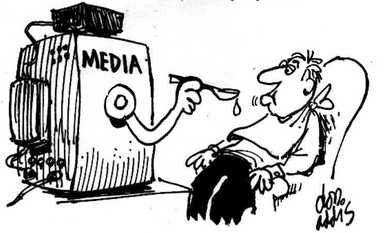
What we don't talk about, though, is deconstructing a commercial on television, or a product ad in a magazine. There are a lot of smoke and mirrors surrounding these things. The use of celebrities to sell water or pizza or makeup is all too common. Playing with emotions to convince you to give money to a charity is common as well. Most of the time, we don't pay attention to these persuasion tricks, which are designed to convince us to do something.
I fall in line with the media literacy movement. The ability to deconstruct media is something that should be taught. Media is all around us. It's better to teach the younger generations about the tricks used out there instead of denying their existence. In both of my subjects, English and Social Studies, I have discussed this. In English, I teach about persuasion techniques. I make the kids aware of the ways that media can trick them. In Social Studies, I discuss politics. We evaluate debates and campaign ads. It's important that everyone knows the techniques used to convince them to vote for a candidate or think a certain way. Fact checking is incredibly important, and goes into the whole concept of deconstructing media.
I really like this image, and I think it goes with what we're saying about media and the need to evaluate it's meaning. When watching advertisements or political debates, we as a public, are being "spoon fed" what those who create this media want us to know and see.
Deconstructing Media

Authors and Audience
This is a magazine cover for the magazine The Blaze for the May 2014 issue. Specifically, Chris Fields wrote the article attached to this image.
I would say that this image is targeted at the parents of students in school. The text says "Common Core's threat to our kids". Our, meaning the person writing must be coming from the standpoint of a parent, speaking to other parents.
Messages and Meanings
The greatest message conveyed is that Common Core is a negative approach to student learning. The cover calls it a "threat". It also displays a message that Common Core makes all students the same. All the students lead up to the thought bubble at the top where it uses the word "Collective". This is the largest word in the image aside from logo, which draws attention to it. When looking at this text, it's impossible not to continue reading to see the full message. At first, it almost seems like the collective idea with the students might be positive, but then you read the subtitle and see that it's not meant to be. If you don't read the entire text, the image can be seen differently.
Those who are against the use of Common Core would benefit from this image. The text implies that these standards are a threat to not only the future of everyone's kids, but also to freedom (uh oh). This is a very inflammatory suggestion. This image is not good for those schools and educators who implement and believe in Common Core. If this image draws people into reading the article, as it is intended to do, then some parents might end up believing the claims and cause outrage over it's use within the schools.
Representation and Reality
The perspective of an educator is left out of this. The message is from the viewpoint of a parent who sees the use of Common Core as negative. It doesn't speak of educators or the students who may have benefited from these standards. This is not a credible or accurate representation, in my opinion. In fact, it's very biased. It holds one stance: Common Core is bad. There's no debate, no indication that it might actually be a good thing (hello, it's a threat to freedom!).
Chris Fields is a conservative Republican, which may be where his bias comes from. Given this information, it's understandable that he sees Common Core as something negative, especially when discussing collaboration among students.
Language and Persuasion
The technique of emotional appeal is clearly the most obvious one. Use of the words threat, freedom, and future are meant to cause an emotional reaction. When discussing this in the context of someone's kids, it's all the more powerful. Along with that, you can add Glittering Generalities, which has the same effect. I would also say that there is use of Loaded Language as well because the word "threat" is used. This word is fairly negative, and creates a strong response with it's use.
Sunday, August 23, 2015
Introductory Post
Hello!
My name is Brittany Morgan, and I'm from Preston County, WV. Currently, I'm teaching English to 6th and 7th grade at South Preston School, which, funny enough, is where I went to Middle School! I am also a student in the Digital Media, Literacies, and Learning Program. So far, I have taken the following courses:
My name is Brittany Morgan, and I'm from Preston County, WV. Currently, I'm teaching English to 6th and 7th grade at South Preston School, which, funny enough, is where I went to Middle School! I am also a student in the Digital Media, Literacies, and Learning Program. So far, I have taken the following courses:
- EDUC 6812: Technology, Leadership, and Change
- EDUC 6814: Game Design and Learning
- EDUC 68301: Research in Education
- EDUC 6809: Teaching in the New Media Age
- EDUC 6816: Information Architecture (aka Curriculum in the New Media Age)
This semester I am taking Programming for Learning (EDUC 5099) and Advanced Educational Technology and Media (EDUC 6305) in addition to this course.
As with all the courses I take within my program, I always look forward to learning more about teaching and using technology. Now that I have a classroom (currently, at least) to test out the things I learn, I'm even more excited! I can't wait to get started!
My Video
Sunday, July 26, 2015
Changing Literacies; Changing Pedagogies
Quotes
"From this perspective, it may be that the new generation of teachers is well placed to develop innovative uses of new technology in the classroom." -- Digital Literacies, Chapter 7
I feel like this can generally be true. Often times, it's the more experienced teachers who have been teaching for years who don't like to change the way they teach. They may use technology occasionally, but it's in simple ways that are mentioned in this chapter, like sometimes using SmartBoards or Laptops. It's a rare occurrence within the classroom. I feel like teachers who are younger and around my age are more open to bringing technology into the classroom, and using them in more innovative ways.
"Education can be enriched by the contributions of new 'playful social' teachers because these are the 'first generation of young teachers to have had the possibility of playful social learning in their social lives'." -- Digital Literacies, Chapter 8
I think that, not only can "playful social" teachers do better with incorporating technology, but that they also connect better with students. It's easier to find commonalities with the students and this helps to make connections. I've connected with both Middle and High School aged students over video games or shows they watch. We've used them for writing assignments or analogies that help them understand content. It also simply helps the teacher build a relationship with the students in the classroom.
"Parallel pedagogy is a way of describing how old and new literacy practices, including print texts and visual texts, may be fruitfully taught side by side, rather than the 'old' being a precursor to the new or being replaced by it." -- Digital Literacies, Chapter 9
This particular quote speaks to me primarily because it's in line with my own teaching beliefs. I love using technology in the classroom and coming up with new ways to incorporate it, but I also love using more traditional texts, like novels. I don't think that novels and books loose their value. Perhaps the way we read has changed, but the act of reading itself shouldn't. I've watched students read print books, graphic novels, on tablets, on e-readers, and even on their phones. There are many ways to combine these two modes of teaching, and using both could even help multiple learners.
"From this perspective, it may be that the new generation of teachers is well placed to develop innovative uses of new technology in the classroom." -- Digital Literacies, Chapter 7
I feel like this can generally be true. Often times, it's the more experienced teachers who have been teaching for years who don't like to change the way they teach. They may use technology occasionally, but it's in simple ways that are mentioned in this chapter, like sometimes using SmartBoards or Laptops. It's a rare occurrence within the classroom. I feel like teachers who are younger and around my age are more open to bringing technology into the classroom, and using them in more innovative ways.
"Education can be enriched by the contributions of new 'playful social' teachers because these are the 'first generation of young teachers to have had the possibility of playful social learning in their social lives'." -- Digital Literacies, Chapter 8
I think that, not only can "playful social" teachers do better with incorporating technology, but that they also connect better with students. It's easier to find commonalities with the students and this helps to make connections. I've connected with both Middle and High School aged students over video games or shows they watch. We've used them for writing assignments or analogies that help them understand content. It also simply helps the teacher build a relationship with the students in the classroom.
"Parallel pedagogy is a way of describing how old and new literacy practices, including print texts and visual texts, may be fruitfully taught side by side, rather than the 'old' being a precursor to the new or being replaced by it." -- Digital Literacies, Chapter 9
This particular quote speaks to me primarily because it's in line with my own teaching beliefs. I love using technology in the classroom and coming up with new ways to incorporate it, but I also love using more traditional texts, like novels. I don't think that novels and books loose their value. Perhaps the way we read has changed, but the act of reading itself shouldn't. I've watched students read print books, graphic novels, on tablets, on e-readers, and even on their phones. There are many ways to combine these two modes of teaching, and using both could even help multiple learners.
Illuminated Text
Sunday, July 19, 2015
Changing Literacies
Quotes
"Other classrooms use their wiki as an information hub. In this context, the wiki becomes the site where homework is posted, where assignments are listed, and where student upload various pieces of work. The wiki is a central point for accessing and disseminating information; for drawing students and teachers together in a community space unhindered by distance and time." -- Digital Literacies, Chapter 4
I have heard about wikis before, but I have never seen them used within the classroom. I really liked the idea of having a kind of classroom site where students and parents could access that displayed everything they might need to know. I work with middle school students a lot, and they can be very forgetful, especially when they don't write information down. If something like this was used, parents would not only be able to see homework assignments and such, but they would also know what was going on in their child's classroom, and even see work that they've done. This, to me, seems like a great idea, and it's rather disappointing that many teachers don't take advantage of the opportunity.
"We now realize that to read online texts in a critical way, one needs to see them as more than free-standing, isolated constructs to be deciphered in the same ways as paper-based texts." -- Digital Literacies, Chapter 5
I really liked the discussion they had here about how blogs were examined for accuracy and realism. When working with online media, there is always the question of whether or not what you're reading is the truth. We ask ourselves the same questions when reading news articles or even watching or hearing about events. The ability to examine text, and the world, critically is a great skill to have. Finding online resources is not always easy, because sometimes information is unreliable. This also relates back to the discussion in Chapter 4 about Wikipedia and it's academic use. Cross-referencing information is always important, and working with digital text can be a good way to teach that.
"The idea that digital technology might help to motivate reluctant learners and provide more meaningful contexts for literacy has captured the attention of an increasing number of educators." -- Digital Literacies, Chapter 6
One of the major questions I think every teacher faces is "How do I teach someone who doesn't want to learn?" What if nothing that is tried in the classroom motivates that student to learn? It's a big issue, and I love the idea that technology can be that motivating factor for students. There was a conversation about the use of video games in this aspect, which is something I find interesting. I think games, whether digital or not, have always been a good motivation for kids, especially those that are younger. I have, however, seen high school kids get excited by the use of games. They're kind of a universal teaching methods that we don't always utilize, because there's this belief that high school kids shouldn't be playing games in class. When dealing with reluctant learners, though, any means that works shouldn't be ignored.
"Other classrooms use their wiki as an information hub. In this context, the wiki becomes the site where homework is posted, where assignments are listed, and where student upload various pieces of work. The wiki is a central point for accessing and disseminating information; for drawing students and teachers together in a community space unhindered by distance and time." -- Digital Literacies, Chapter 4
I have heard about wikis before, but I have never seen them used within the classroom. I really liked the idea of having a kind of classroom site where students and parents could access that displayed everything they might need to know. I work with middle school students a lot, and they can be very forgetful, especially when they don't write information down. If something like this was used, parents would not only be able to see homework assignments and such, but they would also know what was going on in their child's classroom, and even see work that they've done. This, to me, seems like a great idea, and it's rather disappointing that many teachers don't take advantage of the opportunity.
"We now realize that to read online texts in a critical way, one needs to see them as more than free-standing, isolated constructs to be deciphered in the same ways as paper-based texts." -- Digital Literacies, Chapter 5
I really liked the discussion they had here about how blogs were examined for accuracy and realism. When working with online media, there is always the question of whether or not what you're reading is the truth. We ask ourselves the same questions when reading news articles or even watching or hearing about events. The ability to examine text, and the world, critically is a great skill to have. Finding online resources is not always easy, because sometimes information is unreliable. This also relates back to the discussion in Chapter 4 about Wikipedia and it's academic use. Cross-referencing information is always important, and working with digital text can be a good way to teach that.
"The idea that digital technology might help to motivate reluctant learners and provide more meaningful contexts for literacy has captured the attention of an increasing number of educators." -- Digital Literacies, Chapter 6
One of the major questions I think every teacher faces is "How do I teach someone who doesn't want to learn?" What if nothing that is tried in the classroom motivates that student to learn? It's a big issue, and I love the idea that technology can be that motivating factor for students. There was a conversation about the use of video games in this aspect, which is something I find interesting. I think games, whether digital or not, have always been a good motivation for kids, especially those that are younger. I have, however, seen high school kids get excited by the use of games. They're kind of a universal teaching methods that we don't always utilize, because there's this belief that high school kids shouldn't be playing games in class. When dealing with reluctant learners, though, any means that works shouldn't be ignored.
Illuminated Text
Interview Analysis
Hanging Out
Mia spends a lot of time on Social Media. She is active on Facebook, Instagram, and Snapchat, which she uses to communicate with her peers. She also plays a number of games (usually gaming apps) which have been shown to her by her friends. They are games that they usually play together.
Messing Around
Mia doesn't use the computer often, except when she has to do something for school. Most of the time, she is on her Smartphone. However, in relation to the use of her phone, she's taught herself a lot of what she knows and how to use it.
Geeking Out
Mia has not developed an interest in any sort of specialized skill set in relation to technology.
Schooling
Mia has taken several technology courses in high school, such as Basic Computer Applications (BCA). When texting, Mia tends to use correct spelling, though capitalization and punctuation are questionable. Sometimes she uses texting language. Mia has never been much of a reader, but she also does not spend a lot of time sitting in front of a computer, either. Typically, she only writes for school purposes. At this time, she usually uses the computer to do research and write papers.
Mia spends a lot of time on Social Media. She is active on Facebook, Instagram, and Snapchat, which she uses to communicate with her peers. She also plays a number of games (usually gaming apps) which have been shown to her by her friends. They are games that they usually play together.
Messing Around
Mia doesn't use the computer often, except when she has to do something for school. Most of the time, she is on her Smartphone. However, in relation to the use of her phone, she's taught herself a lot of what she knows and how to use it.
Geeking Out
Mia has not developed an interest in any sort of specialized skill set in relation to technology.
Schooling
Mia has taken several technology courses in high school, such as Basic Computer Applications (BCA). When texting, Mia tends to use correct spelling, though capitalization and punctuation are questionable. Sometimes she uses texting language. Mia has never been much of a reader, but she also does not spend a lot of time sitting in front of a computer, either. Typically, she only writes for school purposes. At this time, she usually uses the computer to do research and write papers.
Tuesday, July 14, 2015
Digital Texts in and Out of School
Quotes
"No one form of text reigns supreme; together they construct the multimodal textual landscape of the city." -- Digital Literacies, Introduction
The author used this quote to discuss the way in which people can get around a foreign city, such as Hong Kong, but I think this sort of thing is true even in a place like the classroom. You go from reading a textbook to looking something up on the computer to watching a video or putting together a presentation. There are so many different forms of text and we, as teachers, can't just focus on one of them. They can all work together to enhance learning.
"However, access to technology is never simple--schools have qualitatively different kinds of access, with physical, digital, human, and social resources all impacting on the skills, knowledge, and learning that can be expected." -- Digital Literacies, Chapter 1
As a substitute, I see this very often. I've been to schools who only have one computer lab and no personal computers for the teachers, and others that are rich in technology. Some schools within the same school district are like this, with some having more than others. Integrating technology can be incredibly difficult when the technology itself is not available. It's hard to be innovative when the tools are not there. Many teachers work out of pocket and raise funds on their own to supply their classrooms. Even within the same schools, some classrooms have more than others. Some teachers don't even get the luxury of their own classroom, and instead have to push a cart from room to room and borrow the room's of other teachers. They don't have the same opportunities as the other teachers.
"Literacy is not just about decoding marks on a page; it is also about performing social acts of meaning, where meanings and practices vary according to context." -- Digital Literacies, Chapter 2
This is kind of what we've been talking about throughout the course of this class, that the definition of literacy is changing. Literacy is no longer just the ability to read and write, but to interrupt symbols and what's on a screen. It's also about the skills that can be learned and how they are applied. I like how this also mentions context, because that has a lot to do with how learning is taking place. Sometimes, students have difficulty understanding something in the context of the classroom, but may understand it better when applied in some other way.
"Clare and Tom's formal education has been driven by a strong focus on developing functional skills-based literacy as a result of current high-stakes assessment regimes and teacher accountability." -- Digital Literacies, Chapter 3
I am a firm believer that high-stakes tests are ruining education. So much about student learning and teacher ability is based on these tests. However, most students, especially those in upper middle school and high school, usually don't care about these tests. They don't care if they do well or not. It's a waste of time for them, and they don't see the point. They don't try their best most of the time, even when there is a reward in place. There are also students who are brilliant that are awful at taking tests, and so they don't do well. These tests have nothing to do with their abilities, but how well they can repeat an answer or do what is asked correctly.
Technology and the Classroom
I've always believed that incorporating technology in the classroom is a good thing, and that it can be very helpful to student learning. We talk so much about incorporating technology and how important it is, but sometimes the resources aren't there, or they're so stretched that it's difficult to get them regularly into the classroom. If there is only one computer lab, or one mobile lab, and every teacher wants to use them in the classroom, then it's impossible to get a hold of said lab. It can't become a regular use in the classroom. Not all schools are made equal, and this is especially so in areas where the school districts don't have a lot of money to spend on technology.
"No one form of text reigns supreme; together they construct the multimodal textual landscape of the city." -- Digital Literacies, Introduction
The author used this quote to discuss the way in which people can get around a foreign city, such as Hong Kong, but I think this sort of thing is true even in a place like the classroom. You go from reading a textbook to looking something up on the computer to watching a video or putting together a presentation. There are so many different forms of text and we, as teachers, can't just focus on one of them. They can all work together to enhance learning.
"However, access to technology is never simple--schools have qualitatively different kinds of access, with physical, digital, human, and social resources all impacting on the skills, knowledge, and learning that can be expected." -- Digital Literacies, Chapter 1
As a substitute, I see this very often. I've been to schools who only have one computer lab and no personal computers for the teachers, and others that are rich in technology. Some schools within the same school district are like this, with some having more than others. Integrating technology can be incredibly difficult when the technology itself is not available. It's hard to be innovative when the tools are not there. Many teachers work out of pocket and raise funds on their own to supply their classrooms. Even within the same schools, some classrooms have more than others. Some teachers don't even get the luxury of their own classroom, and instead have to push a cart from room to room and borrow the room's of other teachers. They don't have the same opportunities as the other teachers.
"Literacy is not just about decoding marks on a page; it is also about performing social acts of meaning, where meanings and practices vary according to context." -- Digital Literacies, Chapter 2
This is kind of what we've been talking about throughout the course of this class, that the definition of literacy is changing. Literacy is no longer just the ability to read and write, but to interrupt symbols and what's on a screen. It's also about the skills that can be learned and how they are applied. I like how this also mentions context, because that has a lot to do with how learning is taking place. Sometimes, students have difficulty understanding something in the context of the classroom, but may understand it better when applied in some other way.
"Clare and Tom's formal education has been driven by a strong focus on developing functional skills-based literacy as a result of current high-stakes assessment regimes and teacher accountability." -- Digital Literacies, Chapter 3
I am a firm believer that high-stakes tests are ruining education. So much about student learning and teacher ability is based on these tests. However, most students, especially those in upper middle school and high school, usually don't care about these tests. They don't care if they do well or not. It's a waste of time for them, and they don't see the point. They don't try their best most of the time, even when there is a reward in place. There are also students who are brilliant that are awful at taking tests, and so they don't do well. These tests have nothing to do with their abilities, but how well they can repeat an answer or do what is asked correctly.
Technology and the Classroom
I've always believed that incorporating technology in the classroom is a good thing, and that it can be very helpful to student learning. We talk so much about incorporating technology and how important it is, but sometimes the resources aren't there, or they're so stretched that it's difficult to get them regularly into the classroom. If there is only one computer lab, or one mobile lab, and every teacher wants to use them in the classroom, then it's impossible to get a hold of said lab. It can't become a regular use in the classroom. Not all schools are made equal, and this is especially so in areas where the school districts don't have a lot of money to spend on technology.
Illuminated Text
Friday, July 10, 2015
Media Ecology and Learning Case Interview
Interview
For this case study, I interviewed my cousin, because she is the only young person I happen to know. She is 17 years old and will be a senior in High School.
Ask your young person to choose a pseudonym for you to use in the writing of your case.
For this case study, I interviewed my cousin, because she is the only young person I happen to know. She is 17 years old and will be a senior in High School.
Ask your young person to choose a pseudonym for you to use in the writing of your case.
Mia.
Do you have a computer/iPod/MPC Player/Wii/ect.?
Computer (Desktop & Laptop) - Yes
iPod - Yes
Wii - Yes
iPhone - Yes
TV - Yes
iPod - Yes
Wii - Yes
iPhone - Yes
TV - Yes
What kinds of things do you use the computer for?
Schoolwork mostly. I use my phone for everything else.
What is your favorite thing to do on the computer?
I spend a lot of my time on Social Media.
How did you learn to do that?
I messed around with it and figured out how to do it. Sometimes my friends showed me things and it snowballed from there.
What is your favorite game? Why?
I spent most of BCA II playing BubbleShooter. I also really like 1010. It's like Tetris! BubbleShooter because I always beat my friends at it and it takes a long time to win, so it was very distracting. 1010 because it is also distracting and makes me sleepy.
Do you know other people who do this?
Yeah. All my friends do.
How do you use the computer at school?
I play BubbleShooter (which I'm not supposed to do) and my schoolwork. I have online college classes, projects, research for projects, write papers, and completer classes (business/computer classes).
How would you like to use the computer at school?
I'm more of a hands on learner, so I don't feel I would benefit from virtual learning.
Do you think teachers would let you use the computer to do those things? Why? Why not?
I think they would be more in favor of online lessons. The younger teachers would, but the older teachers are stuck in their ways.
Anything else you would like to tell me?
I think technology can be really helpful if you're a visual learner. It's still beneficial, though, because it's going to keep growing and you're going to have to deal with it in life.
Quotes
"Each generation is exposed to a unique set of events that defines their place in history and shapes their outlook." -- Digital Natives, Chapter 3
"First, there is a general need to stereotype in order to reduce complexity and to apply simplified rules of thumb." -- Digital Natives, Chapter 3
"While numbers of our old routines have remained, in many instances these routines have been added to, augmented, and, in some cases, supplanted by applications of the Internet." -- Digital Natives, Chapter 8
"The findings suggest that rather than a homogeneous population of always connected digital natives, young people's technology activities and interests are widely varying, beyond a core set of common activities involving communication and information retrieval." -- Digital Natives, Chapter 11
"There may indeed be a small subset of young people who are highly adept with and interested in digital technologies, but there is mounting evidence to suggest that patterns of access and use are varied and complex." -- Digital Natives, Chapter 11
Quotes
"Each generation is exposed to a unique set of events that defines their place in history and shapes their outlook." -- Digital Natives, Chapter 3
"First, there is a general need to stereotype in order to reduce complexity and to apply simplified rules of thumb." -- Digital Natives, Chapter 3
"While numbers of our old routines have remained, in many instances these routines have been added to, augmented, and, in some cases, supplanted by applications of the Internet." -- Digital Natives, Chapter 8
"The findings suggest that rather than a homogeneous population of always connected digital natives, young people's technology activities and interests are widely varying, beyond a core set of common activities involving communication and information retrieval." -- Digital Natives, Chapter 11
"There may indeed be a small subset of young people who are highly adept with and interested in digital technologies, but there is mounting evidence to suggest that patterns of access and use are varied and complex." -- Digital Natives, Chapter 11
Saturday, July 4, 2015
Beyond Digital Natives
Quotes
"It had been documents that young children are actually demonstrating an ability to handle screen texts even when not exposed in their own home." -- Digital Natives, Chapter 10
I found this very interesting, especially when discussing children who were not at school age. It makes me wonder where the children have been exposed to technology. To have knowledge of something, children usually have to be exposed to it. If the children haven't been exposed to computers and digital text in their own homes, then where could they have been exposed at? We live in a very digital world, so it stands to reason that somewhere, whether at a daycare or when staying with another family member or a friend, perhaps they were exposed then. I find it hard to believe that children would just know how to operate technology if they hadn't seen and experienced it before.
"There may indeed be a small subset of young people who are highly adept with and interested in digital technologies, but there is mounting evidence to suggest that patterns of access and use are varied and complex." -- Digital Natives, Chapter 11
People, as a whole, are diverse, and sometimes I think we forget that. It's so easy to lump everyone into a group and to apply generalizations to them. In this case, we're saying that all young people are Digital Natives, and that all Digital Natives are good with technology. However, that is not always the case. Sometimes, students don't have that skill set. Also, some students can do more advanced and complex things with a computer. Some may have a basic knowledge of coding while others have no clue what HTML is. These kinds of things are based on the experiences that the students have, not just their age or when they were born.
"We know from our research that for young people to develop sophisticated skills, it is crucial that they have a home where parents support them, schools where teachers support them, and libraries where librarians support them." -- Digital Natives, Chapter 12
I think this is a true statement about everything. In general, children who have more support at home and at school do better. They go further. If parents don't care about their child's grades, then usually the child doesn't care either. There is no motivation or expectation for them. I think the order the areas are listed is important, too. For kids, the learning and interest usually starts at home. Parents are the ones who should push and support their kids and give them every opportunity. Then, the kids come to school, and the teachers should do the same. Teachers should support their students and motivate them to learn. Unfortunately, that is not always the case, and instead of nurturing interests, teachers kill them. Lastly, I think it is important to have librarians who are supportive and willing the help. If a librarian is unapproachable, students are less likely to visit and use the resources available, which will ultimately hinder their learning.
Digital Literacies and Digital Natives
I think the most important idea mentioned in these chapters is that not all digital natives are the same. Not all digital natives are tech savy young adults, and not all digital immigrants are clueless with technology. The truth is, the human race is a diverse group of people, and we all have different interests and different skill sets. Also, the terms digital literacy and literacy are seen as different, but to me, they seem very much the same. Literacy can be defined not only as the ability to read and write, but also as competence in a specified area. Therefore, with this definition, literacy is the same as digital literacy.

"It had been documents that young children are actually demonstrating an ability to handle screen texts even when not exposed in their own home." -- Digital Natives, Chapter 10
I found this very interesting, especially when discussing children who were not at school age. It makes me wonder where the children have been exposed to technology. To have knowledge of something, children usually have to be exposed to it. If the children haven't been exposed to computers and digital text in their own homes, then where could they have been exposed at? We live in a very digital world, so it stands to reason that somewhere, whether at a daycare or when staying with another family member or a friend, perhaps they were exposed then. I find it hard to believe that children would just know how to operate technology if they hadn't seen and experienced it before.
"There may indeed be a small subset of young people who are highly adept with and interested in digital technologies, but there is mounting evidence to suggest that patterns of access and use are varied and complex." -- Digital Natives, Chapter 11
People, as a whole, are diverse, and sometimes I think we forget that. It's so easy to lump everyone into a group and to apply generalizations to them. In this case, we're saying that all young people are Digital Natives, and that all Digital Natives are good with technology. However, that is not always the case. Sometimes, students don't have that skill set. Also, some students can do more advanced and complex things with a computer. Some may have a basic knowledge of coding while others have no clue what HTML is. These kinds of things are based on the experiences that the students have, not just their age or when they were born.
"We know from our research that for young people to develop sophisticated skills, it is crucial that they have a home where parents support them, schools where teachers support them, and libraries where librarians support them." -- Digital Natives, Chapter 12
I think this is a true statement about everything. In general, children who have more support at home and at school do better. They go further. If parents don't care about their child's grades, then usually the child doesn't care either. There is no motivation or expectation for them. I think the order the areas are listed is important, too. For kids, the learning and interest usually starts at home. Parents are the ones who should push and support their kids and give them every opportunity. Then, the kids come to school, and the teachers should do the same. Teachers should support their students and motivate them to learn. Unfortunately, that is not always the case, and instead of nurturing interests, teachers kill them. Lastly, I think it is important to have librarians who are supportive and willing the help. If a librarian is unapproachable, students are less likely to visit and use the resources available, which will ultimately hinder their learning.
Digital Literacies and Digital Natives
I think the most important idea mentioned in these chapters is that not all digital natives are the same. Not all digital natives are tech savy young adults, and not all digital immigrants are clueless with technology. The truth is, the human race is a diverse group of people, and we all have different interests and different skill sets. Also, the terms digital literacy and literacy are seen as different, but to me, they seem very much the same. Literacy can be defined not only as the ability to read and write, but also as competence in a specified area. Therefore, with this definition, literacy is the same as digital literacy.
Meme
This meme goes with the last quote I included, because I believe that this is especially important when it comes to teaching. This is something that is important just in today's teaching world or even in the past. It's also important in the future. Without support from teachers and parents, students are less likely to succeed in everything they do.
Digital Natives Presentation
*set autoplay to 10 seconds*
When putting together my presentation, my attempt was to address the different categories that go with digital natives. All digital natives are not made equal, though we tend to generalize them to make it easier to discuss the current generation. My presentation addresses these generalizations, but it also addresses the differences. I think it's important to know that the majority of this generation have at least a basic knowledge of computers and other technology. Typically, you can expect students to have a basic understanding. However, it's also important to know that some students might not have an extensive knowledge of computers or other technology. Some may also not have an interest in using technology or some technological tool, such as a video game.
Sunday, June 28, 2015
Digital Natives: Navigating Literate Worlds
Quotes
"At the same time there is a public and political awareness about the importance of digital literacy related to education and not such a strong emphasis on testing as in many other countries." -- Digital Natives, Chapter 7
I found this very interesting. There is a great deal of criticism over standardized tests in the United States, and the fact that teachers often "teach to the test". Yet, here is an example of a country that doesn't emphasis standardized tests. Instead, they focus on project-based learning and providing media to students. I'm curious as to how well the students in this country do. We're told that project-based learning is the best way to approach education. We want to use project-based learning because it's fun and has the most benefit, and who likes giving tests anyway? I found it very interesting that there is an importance placed on digital literacy, because sometimes I don't think we put enough on it.
"The Internet has brought about major changes in many aspects of culture and society. It has fundamentally changed the ways in which activities and exchanges are carried out across sectors...While numbers of our old routines have remained, in many instances these routines have been added to, augmented, and in some cases, supplanted by applications of the Internet." -- Digital Natives, Chapter 8
The Internet is a monumental thing. I remember being in elementary school without it, and now I can't imagine not having access. I wouldn't be able to go to school or communicate with people like I do now. What this chapter had to say about the presence of the Internet in our daily lives is so accurate. I would even say that this could apply to technology as a whole. We all have cell phones. Most of us have Smartphones. We still perform the same tasks as our parents or grandparents. We go to school, go to the store, talk to friends, only instead of picking up the landline or getting in our cars and driving to campus, we pull out our phones or log onto our computer or open up Facebook. Because the Internet and technology are such huge parts of our lives, to ignore their importance is not benefitting anyone, especially the students who don't know how to probably search for information when using it.
"Older citizens tend to feel more obligated to participate in elections and government-centered activities whereas young citizens tend to favor more personally expressive or self-actualizing politics." -- Digital Natives, Chapter 9
I found the discussion of young people in politics incredibly interesting. I agree with a lot of what this chapter had to say on the issue. People in my generation and younger don't participate in politics the way that the older generations do. I feel as though a lot of us are more informed, because we have such easy access to what's going on in the world. Social media has connected the younger generation in ways that they have never been before. After the Supreme Court ruling this week, I could not log onto Facebook without seeing something about it. People have been adding the rainbow filters to their profile pictures to show their support. This is part of the self-expressive politics.
The Role of School
Schools and teachers should be responsible for the development of digital literacies, because the development of digital literacies does help with reading and writing. As we've said before, today's people are interacting far more often with text. Just because that text happens to be digital doesn't mean it's not an important part of education. One quote from the book reads: "The results show a strong relationship between students' digital literacy, their general school performance, and the educational background of the parents." Students who have developed their digital literacy skills do better in school. Another piece of evidence to this is when the book talks about the doctoral student who was observed students type an entire question into Google to find an answer. These students have clearly never been taught how to search for information on the Internet. Whether or not they have been taught how, students are going to attempt to find answers through the Internet. If they're going to do it, then we as teachers might as well teach them the proper way to do it.

"At the same time there is a public and political awareness about the importance of digital literacy related to education and not such a strong emphasis on testing as in many other countries." -- Digital Natives, Chapter 7
I found this very interesting. There is a great deal of criticism over standardized tests in the United States, and the fact that teachers often "teach to the test". Yet, here is an example of a country that doesn't emphasis standardized tests. Instead, they focus on project-based learning and providing media to students. I'm curious as to how well the students in this country do. We're told that project-based learning is the best way to approach education. We want to use project-based learning because it's fun and has the most benefit, and who likes giving tests anyway? I found it very interesting that there is an importance placed on digital literacy, because sometimes I don't think we put enough on it.
"The Internet has brought about major changes in many aspects of culture and society. It has fundamentally changed the ways in which activities and exchanges are carried out across sectors...While numbers of our old routines have remained, in many instances these routines have been added to, augmented, and in some cases, supplanted by applications of the Internet." -- Digital Natives, Chapter 8
The Internet is a monumental thing. I remember being in elementary school without it, and now I can't imagine not having access. I wouldn't be able to go to school or communicate with people like I do now. What this chapter had to say about the presence of the Internet in our daily lives is so accurate. I would even say that this could apply to technology as a whole. We all have cell phones. Most of us have Smartphones. We still perform the same tasks as our parents or grandparents. We go to school, go to the store, talk to friends, only instead of picking up the landline or getting in our cars and driving to campus, we pull out our phones or log onto our computer or open up Facebook. Because the Internet and technology are such huge parts of our lives, to ignore their importance is not benefitting anyone, especially the students who don't know how to probably search for information when using it.
"Older citizens tend to feel more obligated to participate in elections and government-centered activities whereas young citizens tend to favor more personally expressive or self-actualizing politics." -- Digital Natives, Chapter 9
I found the discussion of young people in politics incredibly interesting. I agree with a lot of what this chapter had to say on the issue. People in my generation and younger don't participate in politics the way that the older generations do. I feel as though a lot of us are more informed, because we have such easy access to what's going on in the world. Social media has connected the younger generation in ways that they have never been before. After the Supreme Court ruling this week, I could not log onto Facebook without seeing something about it. People have been adding the rainbow filters to their profile pictures to show their support. This is part of the self-expressive politics.
The Role of School
Schools and teachers should be responsible for the development of digital literacies, because the development of digital literacies does help with reading and writing. As we've said before, today's people are interacting far more often with text. Just because that text happens to be digital doesn't mean it's not an important part of education. One quote from the book reads: "The results show a strong relationship between students' digital literacy, their general school performance, and the educational background of the parents." Students who have developed their digital literacy skills do better in school. Another piece of evidence to this is when the book talks about the doctoral student who was observed students type an entire question into Google to find an answer. These students have clearly never been taught how to search for information on the Internet. Whether or not they have been taught how, students are going to attempt to find answers through the Internet. If they're going to do it, then we as teachers might as well teach them the proper way to do it.
Meme
I feel as though we're all guilty of this at some point. Whenever we're not sure of an answer to a question, we immediately pull out our phone or open up our computer and type it into Google. I've been guilty of doing this even when teaching when a student asked me a question I was certain of. I've seen other teachers do this as well. Students, obviously, do this too. When working on homework, if unsure of an answer, or unable to come up with an idea, will type the question or topic into Google. I'll admit that I even searched digital literacy memes tonight to try to come up with something for this metaphor. As a society, we are very reliant on Google.
Sunday, June 21, 2015
The Civic, Social and Multi Modal Lives of Digital Natives
Quotes
"During the last decade increasing attention in both the academic and policy spheres has been devoted to the possibilities offered by the Internet and digital communications technologies for involving young people in political deliberation and civic action." --Digital Natives, Chapter 4
We've obviously seen a great deal of evidence in relation to this. While reading this, I thought back to the 2008 election and how Barack Obama used the internet to raise money and support, and it was seen as such a revolutionary thing. I remember everyone talking about how his use of the internet got the youth involved, and it did. As the technology changes, it always comes into the political spectrum, from radio to television and now the Internet and social media. The same can be said for civic action. Information is spread so quickly through the Internet and social media. The site Change.org has the sole purpose of developing petitions. Now people can post and share links to petitions and have people all over the country support their cause. Kickstarter is great for raising funds in support of projects and causes. It would be irresponsible for policy makers and even academic institutions to not address the benefits that can be had through the use of current technology.
"Thus it was not only the actions of Kato but also those of witnesses that caused widespread shock and criticism both inside and outside of Japan." --Digital Natives, Chapter 5
This happens a lot today. No event can take place anywhere in the world without it being shared on the internet. I can't help but think about all the events that have happened this year, and how social media sites blew up with information about these events. During the events of the Boston bombing and Fergueson, I couldn't log onto Facebook or Tumblr without seeing something related to those events. It's interesting to see that this sort of thing doesn't happen just in our country, but everywhere. It's not just an occurrence here in the United States.
"Generally speaking, off-task work was not portrayed in a negative light on the basis that, it contributed to social cohesiveness... In fact, learner interaction with tasks can change the nature of the envisaged tasks, both in terms of outcome and process." --Digital Natives, Chapter 6
I found it very interesting that conversations considered off-task were included in this study. Many educators hate off-task conversations. They often think that students should be completely focused on the assignment at hand. While the majority of the focus should be on the task at hand, I have to agree that the conversations that happen otherwise are equally important. I've also learned that just because two students might be having a conversation about something else doesn't mean they aren't working on the assignment they've been given. I myself happen to be a major multi-tasker. I can easily write out notes or answer questions while holding a completely different conversation. I like that this particular study didn't portray off-task conversations negatively.
Meme

"During the last decade increasing attention in both the academic and policy spheres has been devoted to the possibilities offered by the Internet and digital communications technologies for involving young people in political deliberation and civic action." --Digital Natives, Chapter 4
We've obviously seen a great deal of evidence in relation to this. While reading this, I thought back to the 2008 election and how Barack Obama used the internet to raise money and support, and it was seen as such a revolutionary thing. I remember everyone talking about how his use of the internet got the youth involved, and it did. As the technology changes, it always comes into the political spectrum, from radio to television and now the Internet and social media. The same can be said for civic action. Information is spread so quickly through the Internet and social media. The site Change.org has the sole purpose of developing petitions. Now people can post and share links to petitions and have people all over the country support their cause. Kickstarter is great for raising funds in support of projects and causes. It would be irresponsible for policy makers and even academic institutions to not address the benefits that can be had through the use of current technology.
"Thus it was not only the actions of Kato but also those of witnesses that caused widespread shock and criticism both inside and outside of Japan." --Digital Natives, Chapter 5
This happens a lot today. No event can take place anywhere in the world without it being shared on the internet. I can't help but think about all the events that have happened this year, and how social media sites blew up with information about these events. During the events of the Boston bombing and Fergueson, I couldn't log onto Facebook or Tumblr without seeing something related to those events. It's interesting to see that this sort of thing doesn't happen just in our country, but everywhere. It's not just an occurrence here in the United States.
"Generally speaking, off-task work was not portrayed in a negative light on the basis that, it contributed to social cohesiveness... In fact, learner interaction with tasks can change the nature of the envisaged tasks, both in terms of outcome and process." --Digital Natives, Chapter 6
I found it very interesting that conversations considered off-task were included in this study. Many educators hate off-task conversations. They often think that students should be completely focused on the assignment at hand. While the majority of the focus should be on the task at hand, I have to agree that the conversations that happen otherwise are equally important. I've also learned that just because two students might be having a conversation about something else doesn't mean they aren't working on the assignment they've been given. I myself happen to be a major multi-tasker. I can easily write out notes or answer questions while holding a completely different conversation. I like that this particular study didn't portray off-task conversations negatively.
Meme

I loved this image when I found it. In the image, the girl is eating breakfast, reading a book, and doing something on her phone. She might even be doing more than one thing while on her phone. The ability to multi-task and work with multiple mediums is a large part of being a digital native. I included the part about 2011 because that was when this book was published.
Saturday, June 13, 2015
Digital Natives: Reflecting on the Myth
Quotes
"Contemporary children have many of the same interests, concerns, and preoccupations as children in previous generations -- even if the ways in which they manifest these through their use of technology is likely to be rather different." -- Digital Natives, Forward
This quote stood out to me as I was reading. It takes me back to when I was ten and I was obsessed with Pokemon. Those who know me well will know that I still kind of am obsessed, but that's not the point. Back then, we played the games, traded Pokemon cards, and watched the television show. We would even play games centered around the whole experience. I still have the binder I collected my cards in at twenty-four years old. Why am I telling you this? Because I see the same things happening with kids today. I've watched fifth and sixth graders trading Pokemon cards at the lunch table and I've overheard them talk about the games and their strategies for accomplishing this and that within the game. I've watched a kid's eyes practically pop out of his head when he saw me carrying around a 3DS and I had to explain to him that it was mine and not one that I confiscated from another student. This is just one of the examples I have related to shared interests across generations. Even though I was born into the start of the digital age, the technology I played the very first Pokemon games on is so much different than what is out today. It's grown and changed. Even the Pokemon cards kids collect are different than when I started my own collection. But at the heart of it, we both (teacher and student) have an interest in the same thing (Pokemon).
"It is not unusual to see self-proclaimed "digital luddites" lamenting the need to escape the control and disruptive interference of email or hear them telling their students to switch off their mobile phones and laptop computers as they enter classrooms. Some have banned the use of Google, Wikipedia, and social media applications in classrooms." -- Digital Natives, Chapter 1
The author's tone in these two sentences suggests that this sort of attitude is a negative thing, which I disagree with. As far as the classroom is concerned, technology always has a time and a place. Should we, perhaps, use more of it? Yes. Should we allow students to keep their phones out at all times and respond to tweets, texts, emails, etc.? No. And that, of course, is exactly what they're doing. I've seen this far too many times to think otherwise. I've been guilty of it myself from time to time. I think we all have. Any device with internet access is a temptation, especially if the subject matter being discussed in class is not of particular interest. I do think that these devices can be useful in the classroom, though. I've often had students use their phones to look things up instead of taking a trip to the computer lab or borrowing the mobile lab. It's easier and more convenient. In this way, though, the technology use is structured. The other part of this I have issues with is the mention of Wikipedia. Wikipedia is usually considered the most "evil" site out there. It's not that the information it provides isn't good, but that it can be changed to anything. None of the reasons mentioned in this section of the book are really why teachers forbid the use of Wikipedia. It is forbidden because it's information cannot always be counted on.
"Having grown up with digital technology as toys, Digital Natives are much more at ease with its use than the generation that did not." -- Digital Natives, Chapter 2
This was another quote that stuck with me as I was reading, because I have a story to go with it. Not too long ago, I was sitting in a team meeting with a group of teachers who were discussing their frustration over the four weeks it took for them to complete their testing. One of the teachers, and one that does not belong in the Digital Native category, said something then, and it reminds me of this. She questioned why they couldn't also make use of the school's iPad labs for testing as well, because it would allow more students to test and cut down the amount of time taken away from class. She also pointed out that while "we" (as in some of the older teachers) were not as comfortable with typing on the iPad keyboard, that many of the students were more familiar with it because they had grown up with it. I think this is a great example as to what this particular chapter was trying to point out, and that's that children today have grown up with the technology, and so they're far better at using it. It's natural to them.
"Each generation is exposed to a unique set of events that defines their place in history and shapes their outlook." -- Digital Natives, Chapter 3
There wasn't a lot in this chapter that I found particularly interesting. This happens to be the first quote that I flagged in my reading, and I happen to agree greatly with it. Every generation, or era if you will, is defined by something. When we think of the 60s or the 80s, we think of music and fashion trends. Kids in my generation are always reminiscing about the 90s, and how everything is just not quite the same. In ten years, the generation after mine will be doing the same. It's a trend that never changes, and what we grow up with defines how we see the world. 90s kids will always complain that TV today is awful in comparison to what we grew up with. I'm sure that older generations could say the same thing about my generation's taste in fashion or music. The current generation will undoubtedly be defined by their use of social media or something of the sort.
Digital Natives
The concept of Digital Natives and Digital Immigrants is an interesting one to me. I had never heard that terminology before. To me, this is actually a really good metaphor for what is occurring in our Digital Age. I feel as though I am a Digital Native. I was born near the start of technology taking off (or at least it feels that way). I remember life without the Internet and Cell Phones. I actually remember when we first hooked our computer up to the Internet, and of course it was the painfully slow Dial-Up of the past. But because I was at the beginning of the era, I grew up with technology, and so I'm really good at working with it. My Mom, on the other hand, is far from the Digital Age and has difficulty even checking her email most of the time. So, where I would be a Digital Native, she is most definitely a Digital Immigrant. Unfortunately, unlike some, she has not quite integrated, and maybe she never will. My Grandmother certainly won't. I don't feel like my thinking on this and how people think, learn, and socialize has really changed, because I'm still a "young person" in my own right. I might understand the concepts just a little bit better, but I've not seen a revolutionary change in my thinking.

"Contemporary children have many of the same interests, concerns, and preoccupations as children in previous generations -- even if the ways in which they manifest these through their use of technology is likely to be rather different." -- Digital Natives, Forward
This quote stood out to me as I was reading. It takes me back to when I was ten and I was obsessed with Pokemon. Those who know me well will know that I still kind of am obsessed, but that's not the point. Back then, we played the games, traded Pokemon cards, and watched the television show. We would even play games centered around the whole experience. I still have the binder I collected my cards in at twenty-four years old. Why am I telling you this? Because I see the same things happening with kids today. I've watched fifth and sixth graders trading Pokemon cards at the lunch table and I've overheard them talk about the games and their strategies for accomplishing this and that within the game. I've watched a kid's eyes practically pop out of his head when he saw me carrying around a 3DS and I had to explain to him that it was mine and not one that I confiscated from another student. This is just one of the examples I have related to shared interests across generations. Even though I was born into the start of the digital age, the technology I played the very first Pokemon games on is so much different than what is out today. It's grown and changed. Even the Pokemon cards kids collect are different than when I started my own collection. But at the heart of it, we both (teacher and student) have an interest in the same thing (Pokemon).
"It is not unusual to see self-proclaimed "digital luddites" lamenting the need to escape the control and disruptive interference of email or hear them telling their students to switch off their mobile phones and laptop computers as they enter classrooms. Some have banned the use of Google, Wikipedia, and social media applications in classrooms." -- Digital Natives, Chapter 1
The author's tone in these two sentences suggests that this sort of attitude is a negative thing, which I disagree with. As far as the classroom is concerned, technology always has a time and a place. Should we, perhaps, use more of it? Yes. Should we allow students to keep their phones out at all times and respond to tweets, texts, emails, etc.? No. And that, of course, is exactly what they're doing. I've seen this far too many times to think otherwise. I've been guilty of it myself from time to time. I think we all have. Any device with internet access is a temptation, especially if the subject matter being discussed in class is not of particular interest. I do think that these devices can be useful in the classroom, though. I've often had students use their phones to look things up instead of taking a trip to the computer lab or borrowing the mobile lab. It's easier and more convenient. In this way, though, the technology use is structured. The other part of this I have issues with is the mention of Wikipedia. Wikipedia is usually considered the most "evil" site out there. It's not that the information it provides isn't good, but that it can be changed to anything. None of the reasons mentioned in this section of the book are really why teachers forbid the use of Wikipedia. It is forbidden because it's information cannot always be counted on.
"Having grown up with digital technology as toys, Digital Natives are much more at ease with its use than the generation that did not." -- Digital Natives, Chapter 2
This was another quote that stuck with me as I was reading, because I have a story to go with it. Not too long ago, I was sitting in a team meeting with a group of teachers who were discussing their frustration over the four weeks it took for them to complete their testing. One of the teachers, and one that does not belong in the Digital Native category, said something then, and it reminds me of this. She questioned why they couldn't also make use of the school's iPad labs for testing as well, because it would allow more students to test and cut down the amount of time taken away from class. She also pointed out that while "we" (as in some of the older teachers) were not as comfortable with typing on the iPad keyboard, that many of the students were more familiar with it because they had grown up with it. I think this is a great example as to what this particular chapter was trying to point out, and that's that children today have grown up with the technology, and so they're far better at using it. It's natural to them.
"Each generation is exposed to a unique set of events that defines their place in history and shapes their outlook." -- Digital Natives, Chapter 3
There wasn't a lot in this chapter that I found particularly interesting. This happens to be the first quote that I flagged in my reading, and I happen to agree greatly with it. Every generation, or era if you will, is defined by something. When we think of the 60s or the 80s, we think of music and fashion trends. Kids in my generation are always reminiscing about the 90s, and how everything is just not quite the same. In ten years, the generation after mine will be doing the same. It's a trend that never changes, and what we grow up with defines how we see the world. 90s kids will always complain that TV today is awful in comparison to what we grew up with. I'm sure that older generations could say the same thing about my generation's taste in fashion or music. The current generation will undoubtedly be defined by their use of social media or something of the sort.
Digital Natives
The concept of Digital Natives and Digital Immigrants is an interesting one to me. I had never heard that terminology before. To me, this is actually a really good metaphor for what is occurring in our Digital Age. I feel as though I am a Digital Native. I was born near the start of technology taking off (or at least it feels that way). I remember life without the Internet and Cell Phones. I actually remember when we first hooked our computer up to the Internet, and of course it was the painfully slow Dial-Up of the past. But because I was at the beginning of the era, I grew up with technology, and so I'm really good at working with it. My Mom, on the other hand, is far from the Digital Age and has difficulty even checking her email most of the time. So, where I would be a Digital Native, she is most definitely a Digital Immigrant. Unfortunately, unlike some, she has not quite integrated, and maybe she never will. My Grandmother certainly won't. I don't feel like my thinking on this and how people think, learn, and socialize has really changed, because I'm still a "young person" in my own right. I might understand the concepts just a little bit better, but I've not seen a revolutionary change in my thinking.
The Digital Generation

I don't know that this is much of a "visual" metaphor, as it is a quote, but I felt like it hit on what I've been talking about in this blog post, and sometimes I think words are the best way to go. This quote, to me, is the definition of a Digital Native, and the Digital Age we live in. Kids today aren't just surfing the web or chatting or playing games, but they're also creating, which is the point. Growing up with technology means that kids today not only know how to use that technology, but they're also improving it and creating their own things, whether it's videos or games or even webpages. They're creating.
Subscribe to:
Comments (Atom)