Sunday, September 13, 2015

Research as Authentic Inquiry

"Children and young people grow up in mediaspheres that adults can find difficult to understand.  Similarly, many young people find the preoccupations of the adult world to be remote, disconnected from their lives, and incomprehensible."  --Digital and Media Literacy, Chapter 2, pg. 29

This quote stuck out to me while I was reading because I've had so many moments that have happened that relate to it.  Because of my age, I often feel like I'm straddling the line between a young adult and an adult.  I read the same books and watch a lot of the same shows that my age group of students do.  We listen to the same music and take interest in the same things.  But at the same time, I'm still an adult with adult worries.  It's funny, though, because my middle school kids see me as an adult.  There was a conversation that took place with my 6th Grade class that involved the game Assassin's Creed.  I made a comment that I had played the game and understood what the student was trying to explain to me.  He was completely baffled that I, his teacher, had actually played a game that he enjoys because teachers aren't supposed to like those same things.

"However, Alvermann and her colleagues point out that youth are ready and willing to talk with adults about popular culture if adults show a willingness to learn."  --Digital and Media Literacy, Chapter 2, pg. 33

This quote sort of goes in line with what I was saying above, and I have to agree.  I'm very open to listening to what my students have to say.  Like with my 6th Grade student above, we were discussing sentences from our grammar book.  One of the sentences mentioned the Gutenberg Printing Press, and I was telling them about it.  This particular student actually knew a lot about it because he'd done a project on it the year before.  Not only that, though, he had played Assassin's Creed, and in one of the games, there is a task that involves the Gutenberg Printing Press.  He immediately went into explaining the concept of the game and the task because I showed interest in what he had to say, even though I already knew about it from playing the game myself.

"Today, many teachers across the curriculum are developing creative strategies to make teaching the research paper more relevant."  --Digital and Media Literacy, Chapter 2, pg. 34

I loved the ideas presented in relation to this quote, as these are the sorts of projects I would enjoy doing with my classes and seeing other teachers do.  In my own class, I'm working on a research project that involves Greek mythology and turning one of the myths into a comic.  When I read the idea, I was fascinated with it, because I thought it would be a fun way to incorporate research and what we're studying in class.  I'm hoping this project works as well as I think it will, and that I can find ideas like it to do in the future.


I found this one incredibly funny, especially since I was having SO MUCH trouble finding a meme that worked with what I wanted to say.  I'm also terrible at making my own.  I should probably be better at this given that I'm part of the younger generation, but I'm really not, so I think this one works perfectly.  I do thing Memes can be good for analyzing and deconstructing media, because this is something they're familiar with.  I think that really any activities that involve the use of media are good for capturing the attention of students, because it's something that's familiar for them, and using those sorts of things in the classroom is very uncommon, so it's something that doesn't feel like school work to them.

Magazine Cover


Emotional Appeals
Since we're talking about children and their education, emotional appeals seems to be the best technique.  I do this with the use of images.  All the kids look happy and excited about education, radiating that Common Core is a positive thing for them.  I also use the tossing of graduation caps to imply that, by being part of Common Core, children will succeed.

Glittering Generalities
Discussing education and the positive future of education go into this category.  Again, the pictures of children succeeding and being excited about education reenforce this idea.

Loaded Language
Words like "future" and "truth" and "facts" are meant to grab attention.  There's also the statement of what the "child's" teacher has to say.  Not just any teacher, but possibly what the one your child is going to have has to say about the curriculum.  These are meant to positively reenforce the idea that Common Core might not be such a bad thing.

Wednesday, September 9, 2015

Reflecting on our Love/Hate Relationship with Media

Media Reflection

Print is probably my favorite form of media, but I have to agree with several comments made about how print media gets ruined (like books getting damaged) and the amount of waste it produces.  When I made my own post, I didn't think about those things until I looked at what is posted.  I found this true with a lot of what my classmates posted.  My first thoughts were always positive, and how much I loved certain things about that type of media.  In fact, it was like this for all the media forms except for sound media, which was the exact opposite.  I was surprised at how many "hate" posts there were for digital media, though, considering the majority of us in this class are digital media majors.  I wasn't expecting this.

Personal Reflection

As I've said, Print is very possibly my favorite media form.  I often choose books over television, whether I'm reading a physical book, or something on my Nook.  When I was reading the comments, though, most people refer to books in the physical sense, and not the digital.  Reading on a Nook or a Kindle is still print based text, it just brings technology into the equation.  I'll admit that I hated eReaders at first.  I tried having a Nook and hated it so much I returned it.  But now as a teacher, with limited time and bag space, I've come to LOVE my Nook and how easy and convenient it can be.  If I'm sitting at home and I finish a book, all I have to do is go online and download the next book instead of driving an hour to the bookstore to get to next chapter.  Even though I might be reading on a screen, though, this is still print media.

I will admit, though, that I have my hates.  For starters, how easily books can be damaged.  It is my biggest pet peeve.  If I loam a book to someone, I expect them to take care of it, and if it becomes damaged in any way, I have to have a new one.  It irritates me to no end when paperback covers get ripped off or pages get water damage.  I feel the same about students who don't take care of textbooks.  Unfortunately, though, no matter how much we might care for our precious books, they can only ever hold up so long before they eventually start to fall apart.

Love Hate Relationship with Media

Print Media


Visual Media


Sound Media


Digital Media


Monday, August 31, 2015

Critical Media Literacy: Core Concepts and Debates

The ability to deconstruct media is so important.  I think everyone is more aware of the tricks that are going on in the media today, yet we're still able to fall victim to them.  I think what Cameron Russell had to say is incredibly important.  There is so much talk about how magazines photoshop images, and that young girls shouldn't feel insecure for not looking the way a model does.  This is a common discussion today, especially with increases in suicides and eating disorders among young girls.

What we don't talk about, though, is deconstructing a commercial on television, or a product ad in a magazine.  There are a lot of smoke and mirrors surrounding these things.  The use of celebrities to sell water or pizza or makeup is all too common.  Playing with emotions to convince you to give money to a charity is common as well.  Most of the time, we don't pay attention to these persuasion tricks, which are designed to convince us to do something.

I fall in line with the media literacy movement.  The ability to deconstruct media is something that should be taught.  Media is all around us.  It's better to teach the younger generations about the tricks used out there instead of denying their existence.  In both of my subjects, English and Social Studies, I have discussed this.  In English, I teach about persuasion techniques.  I make the kids aware of the ways that media can trick them.  In Social Studies, I discuss politics.  We evaluate debates and campaign ads.  It's important that everyone knows the techniques used to convince them to vote for a candidate or think a certain way.  Fact checking is incredibly important, and goes into the whole concept of deconstructing media.


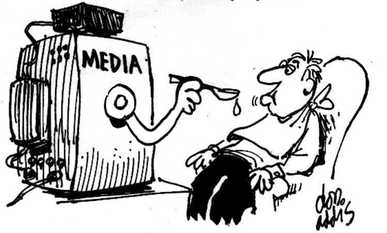
I really like this image, and I think it goes with what we're saying about media and the need to evaluate it's meaning.  When watching advertisements or political debates, we as a public, are being "spoon fed" what those who create this media want us to know and see.

Deconstructing Media


Authors and Audience

This is a magazine cover for the magazine The Blaze for the May 2014 issue.  Specifically, Chris Fields wrote the article attached to this image.

I would say that this image is targeted at the parents of students in school.  The text says "Common Core's threat to our kids".  Our, meaning the person writing must be coming from the standpoint of a parent, speaking to other parents.

Messages and Meanings

The greatest message conveyed is that Common Core is a negative approach to student learning.  The cover calls it a "threat".  It also displays a message that Common Core makes all students the same.  All the students lead up to the thought bubble at the top where it uses the word "Collective".  This is the largest word in the image aside from logo, which draws attention to it.  When looking at this text, it's impossible not to continue reading to see the full message.  At first, it almost seems like the collective idea with the students might be positive, but then you read the subtitle and see that it's not meant to be.  If you don't read the entire text, the image can be seen differently.

Those who are against the use of Common Core would benefit from this image.  The text implies that these standards are a threat to not only the future of everyone's kids, but also to freedom (uh oh).  This is a very inflammatory suggestion.  This image is not good for those schools and educators who implement and believe in Common Core.  If this image draws people into reading the article, as it is intended to do, then some parents might end up believing the claims and cause outrage over it's use within the schools.

Representation and Reality

The perspective of an educator is left out of this.  The message is from the viewpoint of a parent who sees the use of Common Core as negative.  It doesn't speak of educators or the students who may have benefited from these standards.  This is not a credible or accurate representation, in my opinion.  In fact, it's very biased.  It holds one stance:  Common Core is bad.  There's no debate, no indication that it might actually be a good thing (hello, it's a threat to freedom!).

Chris Fields is a conservative Republican, which may be where his bias comes from.  Given this information, it's understandable that he sees Common Core as something negative, especially when discussing collaboration among students.

Language and Persuasion

The technique of emotional appeal is clearly the most obvious one.  Use of the words threat, freedom, and future are meant to cause an emotional reaction.  When discussing this in the context of someone's kids, it's all the more powerful.  Along with that, you can add Glittering Generalities, which has the same effect.  I would also say that there is use of Loaded Language as well because the word "threat" is used.  This word is fairly negative, and creates a strong response with it's use.

Sunday, August 23, 2015

Introductory Post

Hello!

My name is Brittany Morgan, and I'm from Preston County, WV.  Currently, I'm teaching English to 6th and 7th grade at South Preston School, which, funny enough, is where I went to Middle School!  I am also a student in the Digital Media, Literacies, and Learning Program.  So far, I have taken the following courses:

  • EDUC 6812:  Technology, Leadership, and Change
  • EDUC 6814:  Game Design and Learning
  • EDUC 68301:  Research in Education
  • EDUC 6809:  Teaching in the New Media Age
  • EDUC 6816:  Information Architecture (aka Curriculum in the New Media Age)
This semester I am taking Programming for Learning (EDUC 5099) and Advanced Educational Technology and Media (EDUC 6305) in addition to this course.

As with all the courses I take within my program, I always look forward to learning more about teaching and using technology.  Now that I have a classroom (currently, at least) to test out the things I learn, I'm even more excited!  I can't wait to get started!

My Video