Monday, August 31, 2015

Critical Media Literacy: Core Concepts and Debates

The ability to deconstruct media is so important.  I think everyone is more aware of the tricks that are going on in the media today, yet we're still able to fall victim to them.  I think what Cameron Russell had to say is incredibly important.  There is so much talk about how magazines photoshop images, and that young girls shouldn't feel insecure for not looking the way a model does.  This is a common discussion today, especially with increases in suicides and eating disorders among young girls.

What we don't talk about, though, is deconstructing a commercial on television, or a product ad in a magazine.  There are a lot of smoke and mirrors surrounding these things.  The use of celebrities to sell water or pizza or makeup is all too common.  Playing with emotions to convince you to give money to a charity is common as well.  Most of the time, we don't pay attention to these persuasion tricks, which are designed to convince us to do something.

I fall in line with the media literacy movement.  The ability to deconstruct media is something that should be taught.  Media is all around us.  It's better to teach the younger generations about the tricks used out there instead of denying their existence.  In both of my subjects, English and Social Studies, I have discussed this.  In English, I teach about persuasion techniques.  I make the kids aware of the ways that media can trick them.  In Social Studies, I discuss politics.  We evaluate debates and campaign ads.  It's important that everyone knows the techniques used to convince them to vote for a candidate or think a certain way.  Fact checking is incredibly important, and goes into the whole concept of deconstructing media.
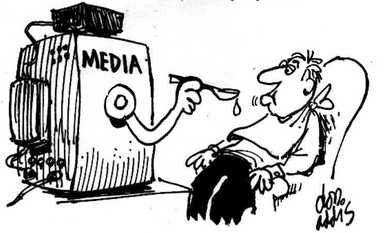

I really like this image, and I think it goes with what we're saying about media and the need to evaluate it's meaning.  When watching advertisements or political debates, we as a public, are being "spoon fed" what those who create this media want us to know and see.

Deconstructing Media


Authors and Audience

This is a magazine cover for the magazine The Blaze for the May 2014 issue.  Specifically, Chris Fields wrote the article attached to this image.

I would say that this image is targeted at the parents of students in school.  The text says "Common Core's threat to our kids".  Our, meaning the person writing must be coming from the standpoint of a parent, speaking to other parents.

Messages and Meanings

The greatest message conveyed is that Common Core is a negative approach to student learning.  The cover calls it a "threat".  It also displays a message that Common Core makes all students the same.  All the students lead up to the thought bubble at the top where it uses the word "Collective".  This is the largest word in the image aside from logo, which draws attention to it.  When looking at this text, it's impossible not to continue reading to see the full message.  At first, it almost seems like the collective idea with the students might be positive, but then you read the subtitle and see that it's not meant to be.  If you don't read the entire text, the image can be seen differently.

Those who are against the use of Common Core would benefit from this image.  The text implies that these standards are a threat to not only the future of everyone's kids, but also to freedom (uh oh).  This is a very inflammatory suggestion.  This image is not good for those schools and educators who implement and believe in Common Core.  If this image draws people into reading the article, as it is intended to do, then some parents might end up believing the claims and cause outrage over it's use within the schools.

Representation and Reality

The perspective of an educator is left out of this.  The message is from the viewpoint of a parent who sees the use of Common Core as negative.  It doesn't speak of educators or the students who may have benefited from these standards.  This is not a credible or accurate representation, in my opinion.  In fact, it's very biased.  It holds one stance:  Common Core is bad.  There's no debate, no indication that it might actually be a good thing (hello, it's a threat to freedom!).

Chris Fields is a conservative Republican, which may be where his bias comes from.  Given this information, it's understandable that he sees Common Core as something negative, especially when discussing collaboration among students.

Language and Persuasion

The technique of emotional appeal is clearly the most obvious one.  Use of the words threat, freedom, and future are meant to cause an emotional reaction.  When discussing this in the context of someone's kids, it's all the more powerful.  Along with that, you can add Glittering Generalities, which has the same effect.  I would also say that there is use of Loaded Language as well because the word "threat" is used.  This word is fairly negative, and creates a strong response with it's use.

Sunday, August 23, 2015

Introductory Post

Hello!

My name is Brittany Morgan, and I'm from Preston County, WV.  Currently, I'm teaching English to 6th and 7th grade at South Preston School, which, funny enough, is where I went to Middle School!  I am also a student in the Digital Media, Literacies, and Learning Program.  So far, I have taken the following courses:

  • EDUC 6812:  Technology, Leadership, and Change
  • EDUC 6814:  Game Design and Learning
  • EDUC 68301:  Research in Education
  • EDUC 6809:  Teaching in the New Media Age
  • EDUC 6816:  Information Architecture (aka Curriculum in the New Media Age)
This semester I am taking Programming for Learning (EDUC 5099) and Advanced Educational Technology and Media (EDUC 6305) in addition to this course.

As with all the courses I take within my program, I always look forward to learning more about teaching and using technology.  Now that I have a classroom (currently, at least) to test out the things I learn, I'm even more excited!  I can't wait to get started!

My Video